The Body in the Store: What Repetitive Strain Can and Cannot Say About Kemet’s Scribes
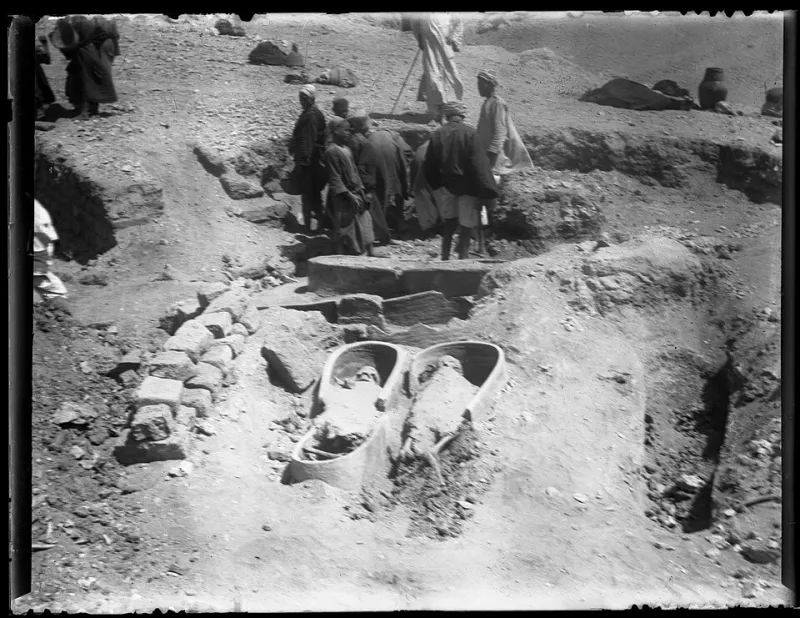
Photo: Unknown, CC0, via Wikimedia Commons
In the quieter parts of Britain’s Egyptian collections, beyond the vitrines and the label text, lie human remains whose bones still carry the marks of lived movement. Osteologists can sometimes identify changes at muscle attachments, joints and vertebral bodies that are consistent with repeated strain. It is tempting to move quickly from those traces to a vivid portrait: the scribe bent over papyrus, the sculptor hunched at the quarry face, the porter carrying loads along the Nile. The evidence rarely supports such tidy characters. The value of studying Kemet’s writing bodies lies less in assigning occupations than in understanding how people worked, aged and adapted — and in being honest about the limits of what bone can tell us.
Reading the skeleton without overreading it
Bioarchaeologists use several indicators when discussing activity. Entheseal changes, or alterations where muscles and ligaments attach to bone, are among the most frequently cited. Osteoarthritis, degenerative joint disease, changes in bone robusticity and particular patterns of wear can also enter the discussion. None of these is a simple record of occupation. Age, sex, body size, genetic inheritance, diet, disease, injury and ordinary variation all shape how a skeleton responds to use. A robust upper arm does not by itself prove that a person threw pots, rowed boats or wrote contracts. It may suggest repeated loading, but the cause remains a matter of interpretation.
That caution is not a reason to abandon the question. It is a reason to ask better ones. Which movements were repeated, in what postures, over what part of a life? How did those patterns differ between people buried in different places or with different grave goods? What can comparative collections in Britain and elsewhere add? The skeleton is an archive, but it is an incomplete and ambiguous one. Reading it well means resisting the appeal of a single, memorable label.
The posture problem
The image of the Egyptian scribe is one of the most familiar in ancient Egyptian art: seated cross-legged, a roll of papyrus across the lap, palette and brush in hand. Tomb models and reliefs reinforce the picture. Yet these are idealised representations, not clinical photographs. They show how scribes wished to be seen, or how workshops chose to depict administrative work. They do not record the variety of actual working positions, the duration of tasks, the use of supports, or the many other kinds of writing and recording that took place in Kemet.
Skeletal evidence for scribal activity is correspondingly difficult to isolate. Repeated fine motor work with a brush or reed pen might leave subtle traces, but so might weaving, beadwork, leatherworking or any number of crafts requiring sustained hand and arm movement. Vertebral changes may reflect long sitting, but sitting was common to many occupations. A skeleton with degenerative changes in the neck and shoulder is not automatically a scribe, and a scribe need not show them. The phrase scribe’s shoulder is a useful shorthand for a question, not a diagnosis.
What British collections can support
UK museums hold Egyptian skeletal material from excavations, donations and older collecting practices, with varying levels of documentation. Some assemblages are well provenanced; others are not. This makes non-destructive study both attractive and ethically demanding. Radiography, CT scanning, surface scanning and photogrammetry can record bones without cutting or sampling them. High-resolution photography and three-dimensional models can be shared with researchers and, where appropriate, with the public. Comparative studies can examine entheseal changes across age and sex groups, or test whether particular joint changes cluster in ways that invite further investigation.
The technical possibilities should not outrun the governance. Human remains in British collections are subject to ethical review, museum policy and increasing attention to repatriation and community consultation. Research access is not a neutral extraction of data. Projects should be transparent about purpose, publication and storage, and should avoid treating remains as a convenient sample for an occupational story. Where descendant communities or source countries have interests, those interests belong in the conversation from the start.
From catalogue label to research question
Museum catalogues sometimes carry occupational labels that were assigned long ago and never revisited. A skeleton described as a scribe may reflect an excavator’s impression, a coffin inscription, an associated palette or simply a hopeful guess. Re-examining such labels is valuable work. It requires cross-checking excavation records, burial context, inscriptions and the history of the collection itself. In many cases the honest conclusion will be that occupation cannot be determined. That is not a failure. It is a finding.
A more defensible approach is to study patterns rather than individuals. If several skeletons from a particular site show similar changes, and if those changes are compared with evidence from architecture, tools, texts and artistic representation, a cautious argument may emerge. Even then, the language should remain conditional: consistent with, possibly associated with, may reflect. The public can handle uncertainty. What it should not be given is a false certainty dressed as science.
A cautious agenda for 2026
As British museums continue to digitise and reconsider their Egyptian collections, there is an opportunity to build better documentation around human remains. That means recording what is known, flagging what is not, and making imaging data available under clear conditions. It means supporting osteological research that publishes negative results as readily as striking ones. It also means resisting the temptation to turn Kemet’s dead into illustrations of modern occupational categories.
The scribe’s shoulder is a compelling image because it promises intimacy with a distant life. The bones may indeed hold traces of that life, but they hold many other things too: age, illness, heredity, labour, care and chance. Reading them responsibly is a conservation matter as much as a scientific one. It asks British collections to preserve evidence, to share it carefully and to describe it with the modesty the material demands.