Glaze Before Clay: Britain’s Long Misreading of Egyptian Faience
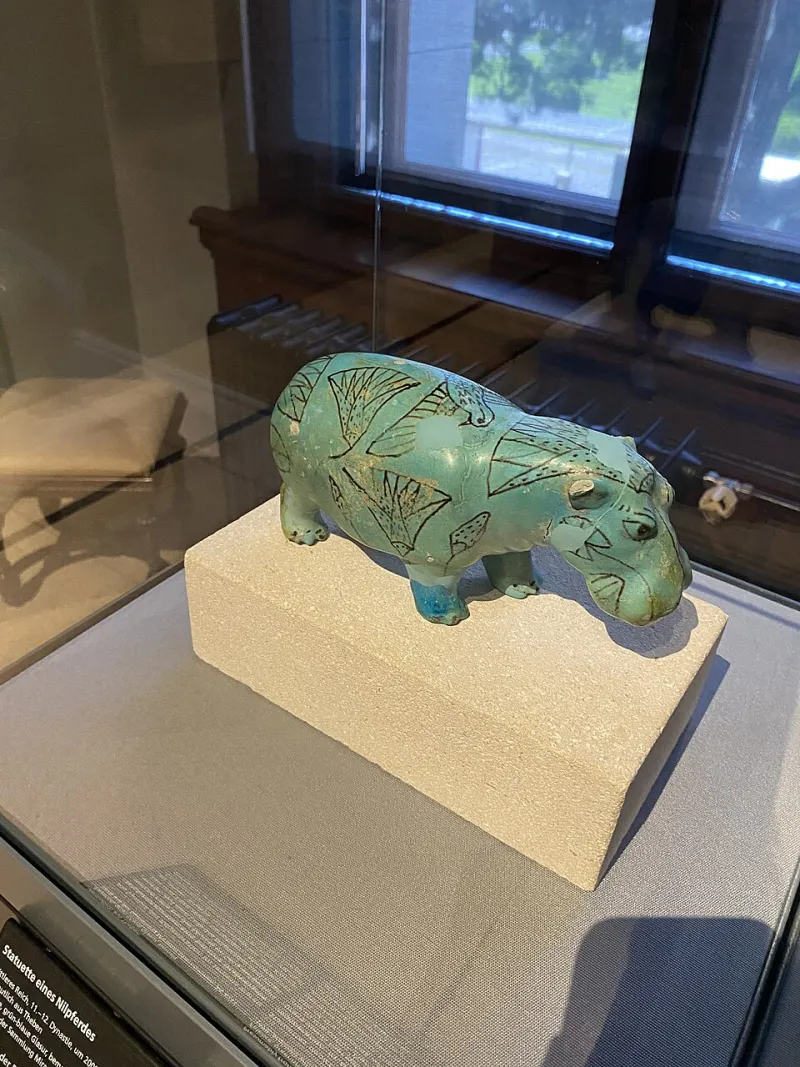
Photo: Furkan Akkurt, CC BY-SA 4.0, via Wikimedia Commons
In museum stores and studio workshops across Britain, Egyptian faience is usually recognised before it is understood. The eye goes first to the colour: a vitreous blue-green, sometimes faded to pale turquoise, sometimes deepened by copper to a near-ultramarine. It is a surface that has tempted ceramicists since the nineteenth century, when Egyptianising wares filled British showrooms and domestic interiors. Yet the history of those imitations is less a story of failed craft than of a category mistake. British potters often chased the look of faience while working within a completely different material system.
A Term That Travels Badly
The confusion begins with the word itself. In European ceramics, faience commonly refers to tin-glazed earthenware: a clay body covered with an opaque white glaze and painted in bright colours. In ancient Egyptian practice, faience is something else entirely. It is a quartz-rich material, made from ground sand or crushed quartz, bound with a small amount of lime and an alkaline flux, then fired so that a glassy surface forms. The body is not clay. The glaze is not a layer of tin enamel. The technology belongs more to glassmaking than to the potter’s wheel.
That distinction mattered little to Victorian manufacturers looking for a saleable Egyptian mood. Trade catalogues and pattern books offered Egyptian borders, lotus motifs and a palette of turquoise and ochre. Staffordshire firms and London retailers could supply the appearance without the method. The results were often handsome in their own right, but they were translations at the level of ornament rather than material. A tin-glazed jug with Egyptian motifs is not a failed piece of faience; it is a successful piece of something else.
The Method Beneath the Surface
Ancient Egyptian faience was made by several routes. In one, soluble salts in the paste migrate to the surface during drying and form a glaze when fired. In another, the object is buried in a glazing powder that fuses to its surface. In a third, a slurry of glaze ingredients is applied directly. Each method depends on a careful relationship between quartz, alkali, copper and heat. The firing temperature must be high enough to create a glassy skin but controlled enough to preserve the shape. The colour comes from copper, sometimes modified by other elements and by the firing atmosphere.
Conservation laboratories in Britain have made this chain of decisions increasingly visible. X-ray diffraction, scanning electron microscopy and thin-section analysis can distinguish a quartz body from a clay body, identify the glaze chemistry and reveal how the surface was formed. Such work is not merely technical. It restores agency to Egyptian makers, showing that faience was a deliberate composite technology, not a primitive precursor to European ceramics. The material was used for amulets, vessels, shabtis, tiles and architectural fittings. Its brilliance was engineered.
Victorian Egypt on the Mantelpiece
The British appetite for Egyptian forms grew through the nineteenth century, fed by exhibitions, travel accounts, museum collections and the design schools that urged manufacturers to study world cultures. Potters responded with sphinxes, scarabs and lotus patterns. Some makers experimented with alkaline glazes and soluble colourants, and a few came close to the visual effect. But the dominant British route remained the clay body and the applied glaze. The recipe books were practical, not archaeological. They sought a repeatable finish for a commercial kiln.
This is where the faience fallacy takes hold: the assumption that because the surface looks Egyptian, the object is a reproduction. In fact, most British Egyptianising ceramics were creative misreadings. They adapted Kemet to the British mantelpiece, the hotel foyer and the museum souvenir shop. Their failure was not a lack of skill. It was a lack of access to the material logic of the original, and sometimes a lack of interest in it.
What Contemporary Makers Can Learn
Today the situation is different. British studios and conservation workshops can draw on published analyses, museum displays and experimental archaeology. A contemporary maker interested in faience can study quartz bodies, alkaline glazes and firing schedules rather than simply mixing a turquoise colour into a tin glaze. That shift matters. It moves the conversation from imitation to translation. The question becomes not how do I make this look Egyptian, but what decisions produced this material in the first place, and what can those decisions teach a maker working in Britain now?
The answer is not that every potter should abandon clay. It is that material knowledge deserves the same attention as motif. Egyptian faience is a lesson in composite thinking: in local materials, controlled heat, and the acceptance that a surface is the visible result of a process. British ceramics have their own deep intelligence, from Staffordshire slipware to studio stoneware. A more honest exchange with Kemet would set those traditions in dialogue rather than disguise one as the other.
A More Honest Display
Museums can help. Labels that explain quartz bodies and alkaline glazes can turn a beautiful object into a legible technology. Display texts that note the difference between Egyptian faience and European tin-glazed faience can prevent a small but persistent confusion. For visitors, the reward is greater than a corrected definition. It is a glimpse of ancient expertise that does not depend on mystery.
The turquoise of Kemet will always draw the eye. But the real lesson lies beneath it, in a body that is not clay and a glaze that is not paint. Britain’s long pursuit of that surface has produced attractive ceramics and instructive failures. The next chapter should be less about chasing the colour and more about understanding the method—an approach that treats Egyptian material knowledge as a living intellectual resource rather than a decorative finish.