When the Stars Kept Office: Rebuilding Kemet's Night Sky in British Domes
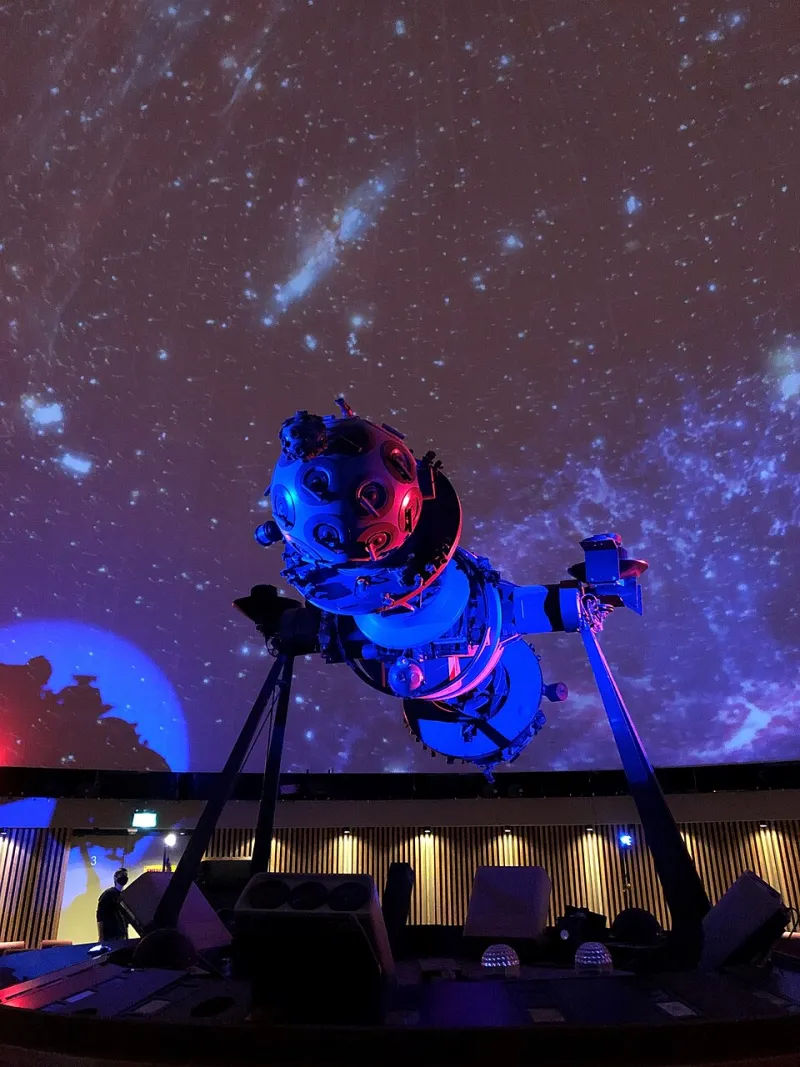
Photo: TMMCommunications, CC BY-SA 4.0, via Wikimedia Commons
On a wet afternoon at the Royal Observatory in Greenwich, a planetarium dome can produce a sky that no one in London can see. The gesture is familiar: stars wheel, labels appear, a narrator explains. But for a small group of curators, astronomers and Egyptologists, the dome is also a laboratory. In 2026, reconstructions of Kemet's night sky are being tested in British planetariums not merely as spectacle but as a way of interrogating fragmentary star records, tomb ceilings and coffin lids. The question is not only what the Egyptians saw, but what our instruments assume before we begin.
A dome is not a neutral window
Planetarium projection has become remarkably precise. Digital systems can place a viewer at any latitude, on any date, and under any level of atmospheric extinction. They can run the sky backwards through precession, the slow wobble of the Earth's axis that changes which stars rise where. For Egyptology, this is a serious research tool. A star ceiling copied from a tomb or temple can be tested against the behaviour of the sky at the latitude of Thebes or Memphis. A decanal list can be checked against the heliacal risings that should have governed its use.
The difficulty is that planetarium software arrives with its own sky. By default, it displays the 88 constellations of the International Astronomical Union, with star names drawn largely from Greek, Latin and Arabic traditions. These are not neutral labels. They are a later settlement imposed on an older, differently organised heaven. When a dome shows Orion, Taurus or Canis Major, it is already interpreting. For Kemet, the relevant groupings may have been Sah, Sopdet or other decanal stars whose identities remain debated. A reconstruction that does not build custom asterisms will quietly overwrite the very sky it claims to recover.
The decanal clock and its uneven evidence
The decans were groups of stars whose risings divided the night and the year. In the Egyptian system, 36 decans were used in clocks that marked the hours and the ten-day weeks, producing a calendar of 360 days before the five epagomenal days were added. The evidence is uneven. Diagonal star clocks survive on Middle Kingdom coffin lids; later star tables and celestial diagrams appear in tombs and temples. Some ceilings, such as the famous astronomical ceiling at Dendera, are elaborate later compositions rather than simple observing manuals. None of this amounts to a complete instruction set.
British collections and archives are part of the record, but often at one remove. Nineteenth- and early twentieth-century Egyptologists made facsimiles, photographs and squeezes of ceilings that have since deteriorated or become harder to access. These records are valuable, yet they carry their own assumptions. A Victorian copyist may have regularised a damaged figure or imposed a familiar classical constellation on an Egyptian grouping. The archive is therefore not a transparent window either. It is a layer of interpretation that must be read alongside the object.
Precession, latitude and the missing horizon
Projection technology makes one problem especially clear: the sky is not fixed. Precession means that a star rising heliacally in a particular decan in the second millennium BCE will not do so in the same way today. A planetarium can correct for this, but the correction must be chosen and explained. It also has to decide which epoch to model. A Middle Kingdom coffin lid, a Ramesside star table and a Ptolemaic temple ceiling do not describe the same sky, even if they share a vocabulary.
Latitude matters just as much. At British latitudes, Sirius sits lower and Canopus is invisible; in southern Egypt, the sky is noticeably different. A dome in Leicester, Bristol or Glasgow can simulate the Egyptian horizon, but it can also show the British one. That comparison is pedagogically useful. It exposes the common assumption that the night sky is a universal backdrop. In practice, the horizon is part of the instrument. So is atmospheric clarity. The Egyptian sky was not the light-polluted sky of modern Britain, and a reconstruction that ignores extinction and visibility may produce stars that no ancient observer could have seen at the relevant altitude.
What British planetariums can add
Institutions such as the Royal Observatory Greenwich, the National Space Centre in Leicester, Jodrell Bank Discovery Centre and science centres in Bristol, Glasgow and Edinburgh are well placed to present this material. They combine public audiences with technical capacity and, increasingly, with access to university astronomy departments. The best work does not treat Kemet as a decorative prelude to Greek astronomy. It shows the decanal system as a practical and religious technology: a way of organising time, scheduling ritual and mapping the divine order onto the sky.
That means showing uncertainty. A planetarium can display three competing identifications of a decanal star side by side, or toggle between an Egyptian asterism and the modern constellation that now occupies the same region. It can mark which stars are attested, which are inferred and which are modern additions. This is not a concession to doubt; it is the honest form of reconstruction. The dome becomes a conservation tool for intangible heritage, not a theatre of false certainty.
The quiet overwrite
The risk is not that planetariums will get the astronomy wrong. It is that they will get the framing wrong. A show that uses modern constellations as the default grid, adds a few Egyptian labels and calls the result Kemet's sky has not reconstructed anything. It has reupholstered the modern sky in ancient colours. The more demanding approach is slower: build the Egyptian asterisms, justify the epoch, model the horizon, annotate the archive, and let the audience see where the evidence runs out.
In 2026, that approach is still uneven across Britain. But the dome offers something rare: a way to make ancient timekeeping visible without pretending it is fully known. When the stars kept office over Kemet, they did so in a sky that was observed, named and argued over. A good planetarium can recover some of that argument, provided it resists the temptation to let the modern sky have the last word.