The Needle by the Tideway: London’s Obelisk and the Test of Outdoor Stewardship in 2026
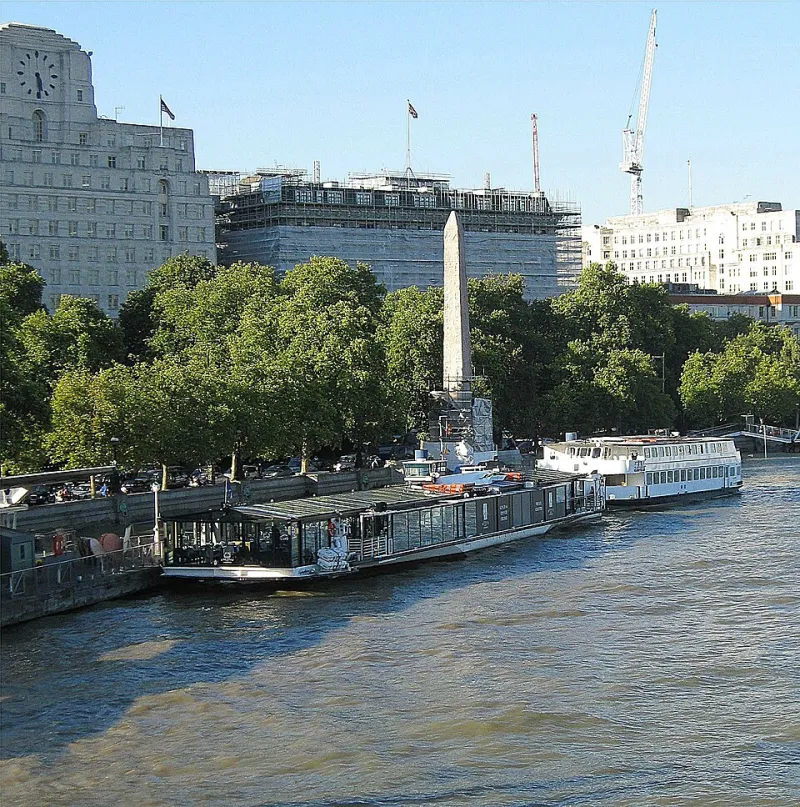
Photo: Glenn Ashton, CC BY-SA 3.0, via Wikimedia Commons
Cleopatra’s Needle is easy to miss. Set back from the traffic on the Victoria Embankment, the granite obelisk rises beside the Thames with the quiet confidence of something that has outlasted several empires. Visitors pass it on the way to the South Bank or the Embankment underground station, often without reading the inscriptions or noticing the bronze sphinxes at its base. Yet this single monument is one of London’s most revealing test cases for Egyptian heritage outdoors. It is ancient, it is exposed and it cannot be protected by a museum vitrine.
The obelisk did not begin its life as a London landmark. It was made in Egypt, inscribed for Thutmose III and later augmented under Ramesses II, and stood at Heliopolis before being moved to Alexandria. In 1819, Muhammad Ali offered it to Britain. The gift was accepted, but the practicalities were formidable. The obelisk remained in Alexandria for decades while British officials debated how to move a single block of granite weighing more than two hundred tons.
A gift that took sixty years
The eventual transport was a Victorian engineering drama. The obelisk was encased in an iron pontoon and towed by a steamer, but the voyage ran into severe weather. The operation claimed the lives of six seamen, and the obelisk itself was nearly lost before it reached London. It was erected on the Victoria Embankment in 1878, where it joined the Victorian riverfront improvements as a monument to imperial reach and engineering confidence.
That history is worth telling, but it is not the whole story. The obelisk is not a Victorian trophy that happens to be Egyptian. It is an Egyptian monument whose London life is a relatively recent chapter. The inscriptions on its surface belong to a much older religious and political world. Any interpretation that stops at the transport saga risks turning Kemet into a footnote to British ingenuity.
Reading a monument in London’s weather
Granite is durable, but it is not inert. For more than a century the obelisk has been exposed to coal smoke, traffic emissions, river humidity, salt-laden air and the ordinary cycles of rain, frost and sun. The inscriptions have softened. Surface detail has been lost. Biological growth has appeared in sheltered areas. The stone records London’s atmosphere as surely as any written archive.
Outdoor heritage faces pressures that indoor collections do not. A museum can control temperature, humidity and light. An obelisk on a public embankment cannot. It must endure the capital’s microclimates, the vibration of nearby traffic and the occasional flood event. The Thames is not a decorative backdrop; it is an active environmental system. In 2026, with hotter summers and more intense rainfall becoming part of the UK’s planning assumptions, the question is not whether the monument will change, but how quickly and in what ways.
Conservation beyond the plinth
Conservation is often imagined as cleaning. In practice, the most responsible approach is usually more restrained. Aggressive cleaning can remove original surface and accelerate decay. Biocides can have unintended effects. Repairs should be evidence-led, documented and, where possible, reversible. The aim is not to make an ancient object look new, but to slow deterioration without erasing the marks of time.
For Cleopatra’s Needle, care also extends beyond the granite. The bronze sphinxes, the base, the surrounding pavement and the sightlines from the embankment all shape how the monument is experienced. Lighting, signage and accessibility matter. So does the interpretation. A visitor should be able to understand both the Egyptian origins of the obelisk and the Victorian circumstances that brought it to London. The two histories are not rivals; they are layers of the same object.
Outdoor stewardship also requires partnership. No single museum, council or heritage body can manage a monument like this alone. Conservation scientists, structural engineers, local authorities, riverside managers and Egyptian heritage specialists all have relevant expertise. A condition review in 2026 should be a shared exercise, not a private technical report filed away after completion.
What a 2026 condition review should ask
A useful review would begin with change. What is deteriorating, at what rate and why? Which surfaces are original, which are Victorian interventions and which are later repairs? How do water, salt and pollution move across the stone? What does the monument’s setting contribute to its decay, and what could be changed without harming the public realm?
The review should also ask harder questions about use. Is the obelisk primarily a piece of street furniture, a tourist sight, a diplomatic relic or an Egyptian antiquity in exile? What level of public access is appropriate? How should the site explain the deaths that occurred during transport? And how can Egyptian expertise be built into decision-making rather than consulted after the fact?
These are not abstract concerns. They determine whether conservation is a one-off clean-up or a long-term relationship. The difference matters in a city that is constantly rebuilding around its monuments. An obelisk can survive a storm at sea and still be worn down by decades of unsympathetic maintenance.
A civic responsibility
Cleopatra’s Needle is often described as a London landmark, and in a practical sense it is. But it is also a reminder that UK cities hold Egyptian heritage in public places, not only in museum galleries. That heritage requires more than occasional inspection. It requires a clear philosophy of care, honest interpretation and a willingness to accept that the monument is not solely British property in meaning.
In 2026, the obelisk by the Thames is a modest but exacting test. It asks whether London can look after an ancient Egyptian object outdoors with the same seriousness it applies to its own Victorian monuments. The answer will be read in the stone itself, year by year, for generations to come.