Stone Guardians of the Suburbs: Finding Egypt in British Streets
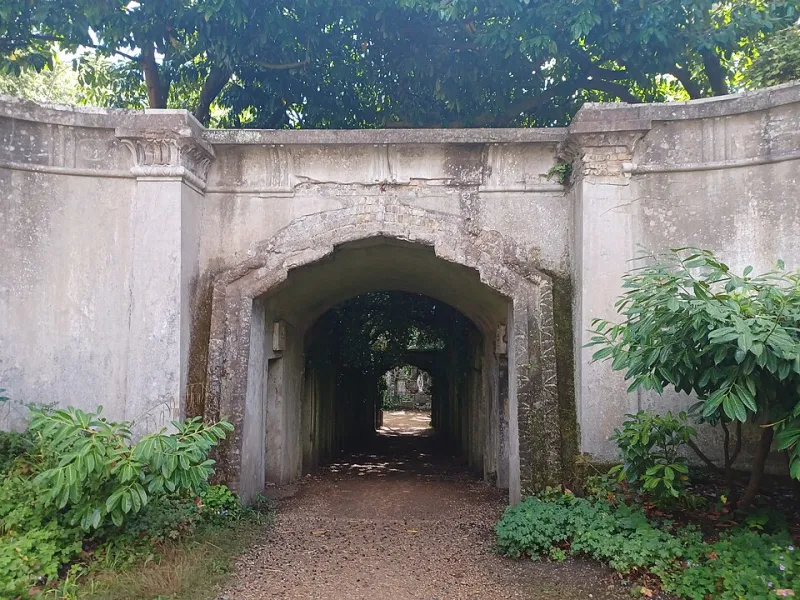
Photo: Simon Burchell, CC BY-SA 4.0, via Wikimedia Commons
Egyptian Revival architecture is easy to miss because it seldom arrives as a complete temple. It appears instead as a pair of battered gateposts, a cavetto cornice above a doorway, a lotus capital on a chapel, or an obelisk in a municipal cemetery. Across the UK, these fragments form a scattered field guide to the way ancient Kemet entered British design — not as accurate archaeology, but as a flexible language of antiquity, permanence and mystery.
How Kemet became a British architectural language
Napoleon's Egyptian campaign of 1798–1801 and the later publication of the Description de l'Égypte put pharaonic forms into wide European circulation. British architects did not set out to reconstruct Egyptian buildings. They extracted motifs — pylon towers, winged sun discs, tapering columns, obelisks and lotus capitals — and applied them to chapels, factories, shops, prisons and cemeteries. The result was less scholarship than theatre. Egypt could signal learning, commerce, mourning or civic ambition, depending on the building.
The Egyptian Hall in Piccadilly, opened in 1812, was the movement's London shop window; it was demolished in 1905, but its influence lingered. In the Victorian period, the style became especially useful to the cemetery movement. Egyptian forms suggested eternity without requiring Christian iconography, which suited the new garden cemeteries and their commercial family vaults.
Where to look first: cemeteries
Highgate Cemetery's Egyptian Avenue, built in the late 1830s, is the classic London example: a catacomb entrance framed by battered walls and columns, leading to family vaults. It is not a temple, and that is precisely the point. It is cemetery design using Egyptian vocabulary to frame memory and status. Similar motifs appear in other Victorian burial grounds, where obelisks, pylon gateways and Egyptian-style mausoleums survive in varying states of repair.
Outside London, the Egyptian House in Penzance shows the style in a seaside town, while Temple Works in Holbeck, Leeds, applied pylon-like forms to a nineteenth-century flax mill. These are not pious copies. They are British buildings wearing Egyptian clothes, and they reveal how easily Kemet could be adapted to very un-Egyptian purposes.
Cinema façades and institutional oddities
After the discovery of Tutankhamun's tomb in 1922, Egyptian motifs entered popular entertainment. The former Carlton Cinema on Essex Road, Islington, opened in 1930 and retains an Egyptian Revival façade; other super-cinemas used lotus capitals, sunbursts and stepped pylon fronts to create an exotic interior. The style also appeared on Masonic halls, chapels and institutional gatehouses, where pylon massing projected order and antiquity. Some Victorian prison and asylum buildings borrowed the same vocabulary, though survivals are often fragmentary and best checked against Historic England listing descriptions before making a special journey.
A weekend itinerary
For a London-based weekend, begin on Saturday morning at Highgate Cemetery. Check opening arrangements in advance, since parts of the site are accessible only on guided tours. The Egyptian Avenue is a working cemetery feature, not a visitor attraction in isolation, so allow time and follow site rules. In the afternoon, visit the British Museum's Egyptian sculpture gallery for context — not because the architecture is there, but because the objects explain why British designers were so receptive to Egyptian forms. Finish with a walk past the former Carlton Cinema on Essex Road.
On Sunday, choose a second cemetery with Egyptian-style tombs or gate lodges, or visit the Petrie Museum for the object-level history that underpins the revival. Readers outside London can build a local route instead: a Victorian cemetery, a civic building with Egyptian detailing, and a regional museum with Egyptian antiquities. Leeds, Penzance and Manchester all repay a detour, but the best starting point is usually the nearest large Victorian burial ground.
Field notes for the curious
Not every obelisk is Egyptian Revival; many are war memorials or general classical monuments. Look for the combination of battered walls, cavetto cornices, lotus or papyrus capitals and sphinx-like figures. Respect private property and active burial grounds, avoid photographing mourners, and do not treat cemeteries as open-air museums. The pleasure of this architecture lies in its oddness: a style imported for tombs and temples, repurposed for mills, cinemas and suburban vaults. Kemet is not next door in any literal sense, but its British afterlives are closer than most streets suggest.