Stones of Whim: A Traveller's Guide to Britain's Egyptian Follies
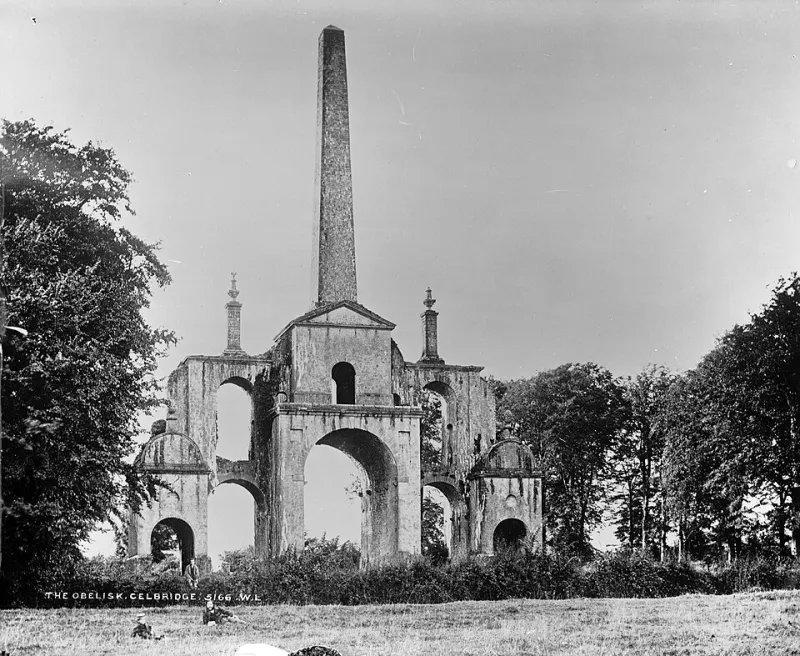
Photo: National Library of Ireland on The Commons, Public domain, via Wikimedia Commons
There is a moment on a walk through an English estate when the landscape suddenly stops pretending to be English. A pyramid rises above the beeches. An obelisk interrupts a ha-ha. A gateway of battered, tapering columns appears where a dairy ought to be.
These are Britain's Egyptian follies, and there are more of them than most people expect. They range from the genuinely grand to the frankly eccentric, and almost all of them date from a period when a very small number of people possessed both the wealth and the leisure to rebuild the world in their gardens.
Why Britain built its own Nile
Georgian and Victorian Britain had a complicated appetite for ancient Egypt. Scholars were beginning to read the hieroglyphs; travellers were bringing back antiquities; prints of Luxor and Philae circulated in drawing rooms. For landowners on the Grand Tour, Egypt offered the lure of the immense and the ancient without the inconvenience of the journey.
Crucially, these were private commissions. Nobody was asking an architect to represent Egypt accurately. They were asking for a mood: solemnity, permanence, a hint of the funerary. The result is a body of structures that tell us far more about British taste, wealth and imperial confidence than about the Nile valley itself, which is precisely why they are worth a detour.
1. The Pyramid at Brightling, East Sussex
The starting point for any survey is the pyramid mausoleum in the churchyard of St Thomas à Becket at Brightling, built for John 'Mad Jack' Fuller, squire, MP and irrepressible eccentric. Erected in the opening decade of the nineteenth century, it is a squat, assured, unapologetic pyramid, and Fuller is said to have intended to be buried inside it seated upright at a table, in full dress, with a bottle of claret to hand. The story may be embellished. The pyramid is not.
Fuller also left an obelisk and a curious conical tower nearby, so a short circuit of the parish delivers a crash course in the genre.
2. The Obelisk at Castle Howard, North Yorkshire
Among the earliest of the British obelisks, the great needle in the grounds of Castle Howard dates from the early eighteenth century and is usually credited to Sir John Vanbrugh. Standing some thirty metres high in open parkland, it is less an imitation of Egypt than a statement of dynastic confidence, and it demonstrates the pattern that repeats across this list: the Egyptian form, stripped of its context, deployed to say something thoroughly British about lineage and permanence.
3. The Philae Obelisk at Kingston Lacy, Dorset
Here the tone changes. The obelisk brought back by William John Bankes in the 1820s was raised at Kingston Lacy with its inscriptions intact, and it mattered to the history of scholarship as well as to the history of taste. Its bilingual text, in hieroglyphs and Greek, gave Bankes and his contemporaries a working tool in the race to decipher Egyptian writing. The house itself holds an Egyptian Room, complete with a painted ceiling of figures.
The estate is now in the care of the National Trust, which is candid about the family fortune's dependence on Caribbean plantations. That context is not a footnote; it is part of what a visit here is for.
4. The Egyptian Court at Biddulph Grange, Staffordshire
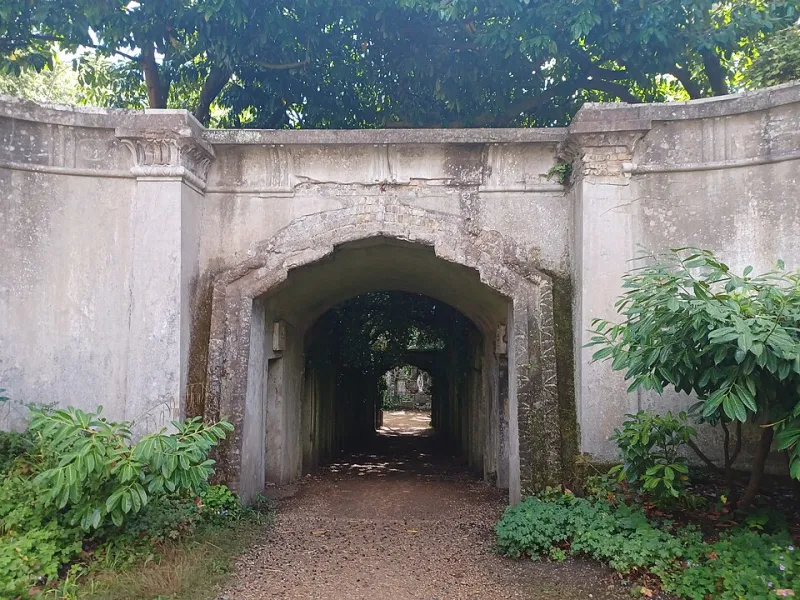
James Bateman's garden is a Victorian anthology of the world in miniature, and the Egyptian Court is its sternest chapter: a stylised temple frontage framed by dark planting, reached by way of a tunnel. It is theatrical, knowingly inauthentic, and all the more interesting for it. The book your ticket at the same time as the Chinese garden and the Himalayan glen, and you have a working model of nineteenth-century Britain imagining everywhere at once.
5. The Egyptian House, Penzance, Cornwall
Not a folly at all, strictly speaking, but a commercial building of the 1830s with one of the most striking Egyptian Revival façades in the country, its tapering columns and lotus capitals pushing out over Chapel Street. It was built for a mineralogist and is now let by the Landmark Trust, which means you can, if you are quick and fortunate, stay in it.
Reading them responsibly in 2026
The temptation with structures like these is to treat them as jokes. Mad Jack's pyramid invites it; the Biddulph temple almost demands it.
But a folly is a document. Each of these buildings records a moment when a wealthy Briton could appropriate the forms of another culture as garden decoration, and each was built on wealth that often came from elsewhere. Enjoying them is not incompatible with noticing that. The better visit asks two questions: who paid for this, and what did they think Egypt was?
Practicalities matter too. Several are on private land or within working churchyards. The Brightling mausoleum sits among active graves, and visitors should treat it as a place of burial rather than a photo opportunity. Obelisks and pyramid roofs are not climbing frames and are often structurally fragile. Where a site is National Trust, Historic England-listed or Landmark Trust, its own guidance is the one to follow.
Before you go
Check opening seasons before travelling. Biddulph Grange and Kingston Lacy keep garden hours that change through the year, and Penzance is best visited on foot. Brightling is a small village with limited parking, so combine it with a longer walk and arrive quietly. Castle Howard's grounds are ticketed, and the obelisk is best seen on the approach rather than treated as a destination in itself.
Take a notebook. The pleasure of these stones is not that they are Egyptian. It is that they are a record of Britain talking to itself about Egypt, in public, in stone, for two hundred years.