The Cost of Keeping Time: Egypt’s Organic Past in Britain’s Climate-Controlled Stores
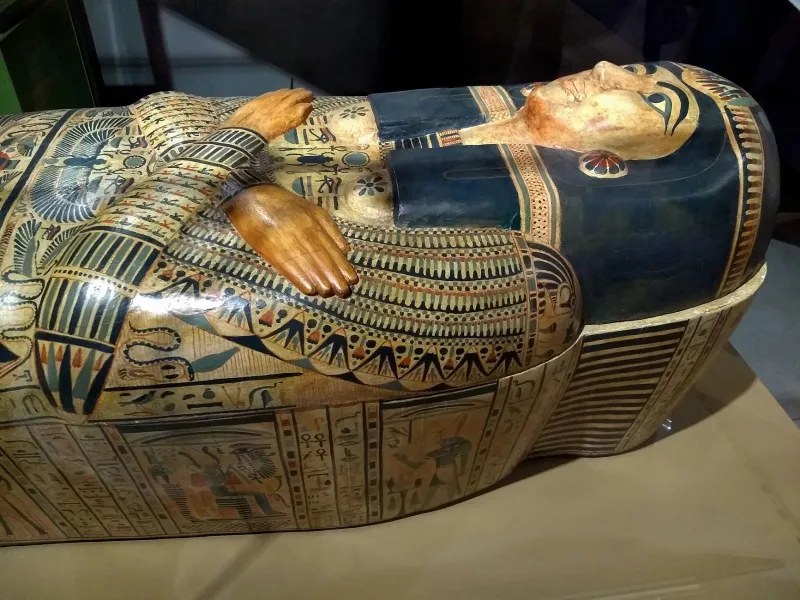
A wooden coffin is not one object. It is timber, gesso, pigment, varnish, linen, resin and, often, air trapped in old joins. Each material responds differently to the room around it. That is why the quietest spaces in Britain’s Egyptian collections — the stores, the conservation labs, the cases with their small sensors — are also among the most contested. They embody a promise to keep Kemet’s organic past from turning to dust, and a bill that someone must pay.
The Setpoint and the Bill
In 2026, the debate is no longer abstract. Museum budgets in the UK remain under pressure, and the cost of electricity is a line item that curators and conservators watch as closely as they watch relative humidity. A gallery set at a steady temperature may look passive to a visitor. Behind the wall, plant runs, dehumidifiers cycle, filters are changed and alarms wait to sound.
The old instinct was to cool everything and hold it still. Modern conservation is more nuanced. For organic Egyptian materials, stability often matters more than a single ideal number. A coffin that swings between damp and dry is at greater risk than one kept at a slightly warmer but steadier condition. The science has moved toward risk-based decisions, but the infrastructure has not always moved with it. Many UK museums inherited plant designed for a different era of cheap energy and different expectations of what a collection should feel like.
What Decay Wants
Decay is not a moral failure; it is chemistry. Wood is hygroscopic: it takes up and releases moisture from the air. When relative humidity rises, cell walls swell; when it falls, they shrink. In a painted coffin, the gesso ground and pigments do not always move at the same rate as the wood beneath. Cracks open, flakes lift, and old repairs reveal their limits. Linen behaves differently again, becoming brittle as fibres age and as light and oxygen do their slow work. Papyrus, a cellulosic material, is vulnerable to both moisture and excessive dryness, and to light that fades ink.
Temperature matters because it speeds reactions. Cooler conditions generally slow deterioration, but the relationship is not a licence to chill a store to any arbitrary point. Condensation is the enemy of a cold room. If a object is moved from a cold store into warmer air, moisture can settle on its surface. Dew point, not just temperature, governs the risk. This is why conservation advice so often sounds cautious: the object is not merely old, it is a composite system, and the room is part of that system.
The Wood, the Linen, the Papyrus
Egyptian coffins present a particular challenge because of scale. A large wooden coffin may be too fragile to travel, too bulky for a standard case, and too irregular for a simple microclimate. Conservators may use padded supports, custom mounts and slow acclimatisation. Textiles demand low light and careful support; a fragment of linen can be strong in one direction and powdery in another. Papyri are often stored flat, interleaved and protected from light, with access limited because every exposure is a small cost.
In stores, the ideal is not a single cold room for everything. It is zoning: cooler, drier conditions for particularly vulnerable material; stable, less energy-intensive conditions for objects that can tolerate them; and clear separation between display, study and long-term storage. That approach sounds technical, but it is also a budget strategy. The most sustainable environmental control is often the one that avoids conditioning air that does not need conditioning.
Net Zero Meets the Hygrothermograph
Britain’s museum sector has committed itself to reducing carbon emissions, and many institutions have published net-zero targets. Electricity from renewable tariffs helps, but it does not erase the operational footprint of climate control. Building fabric, glazing, lighting and visitor comfort all interact. A gallery that is comfortable for people may be warmer than a store that is ideal for coffins; a store that is sealed against pests may also trap heat.
The tension is real. Lowering energy use by allowing wider environmental fluctuations can save carbon and money, but it shifts risk onto objects and staff. Keeping strict conditions protects vulnerable material, but may lock museums into high consumption and make loans and touring harder to justify. Neither position is a simple virtue. A museum that turns down its plant without monitoring is not sustainable; it is merely less careful. A museum that refuses to reconsider its setpoints is not rigorous; it is refusing to account for the future it claims to protect.
A Middle Path, Not a Compromise
The more credible path is neither heroic austerity nor business as usual. It is evidence-led stewardship: better sensors, better data, shared stores, passive or low-energy solutions where they can be shown to work, and a willingness to prioritise the objects most at risk. Some UK museums are already exploring grouped storage and tighter loan policies. Others are reviewing whether every gallery needs the same conditions as every store.
For visitors, the result may be invisible. A coffin remains behind glass; a papyrus remains in its folder. But the cold room is now a place where conservation, finance and climate policy meet. The question for Britain’s Egyptian collections in 2026 is not whether preservation matters. It is whether the sector can describe, honestly, what preservation costs — and who is prepared to keep paying for it.