Guardians in Stone: The Egyptian Revival Graves Britain Has Yet to Record
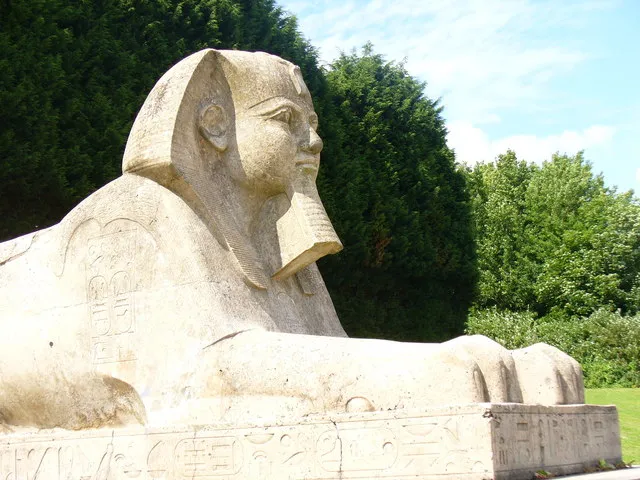
Photo: Colin Smith, CC BY-SA 2.0, via Wikimedia Commons
Britain’s cemeteries are rarely treated as galleries of ancient taste. Yet a walk through a Victorian garden cemetery can turn up obelisks, cavetto cornices, lotus capitals and, in a small number of cases, a recumbent sphinx. These are the surviving traces of an Egyptian revival in funerary architecture that flourished from the 1830s to the early twentieth century. They are strange, striking and often poorly recorded. For anyone interested in how Kemet was received in Britain, they are also unusually candid evidence.
A Language of Empire and Eternity
The Egyptian revival in British cemeteries belonged to a wider nineteenth-century enthusiasm. Napoleon’s campaign in Egypt, the publication of the Description de l’Égypte, the arrival of obelisks in London and Paris, and later Britain’s occupation of Egypt in 1882 all fed a public appetite for Egyptian forms. That appetite was not always scholarly. Pattern books, mason’s catalogues and travel accounts circulated motifs more widely than accurate knowledge of pharaonic religion or chronology.
In the cemetery, those motifs acquired a new purpose. The obelisk, already a familiar form in classical and Masonic contexts, could suggest solar permanence and antiquity. The winged sun disk offered protection; the sphinx suggested guardianship. A cavetto cornice or a battered wall evoked temple architecture without requiring a detailed reconstruction of one. The result was a funerary language that was less about ancient Egyptian belief than about British ideas of death, empire and cultural prestige.
The cemetery movement itself mattered. Large garden cemeteries on the outskirts of cities offered space for ambitious monuments. Nonconformist burial grounds, Anglican churchyards and municipal cemeteries all developed their own conventions, but Egyptian motifs crossed denominational lines. The Egyptian Avenue at Highgate Cemetery, opened in 1839, is the best-known architectural set piece, but the more common survivals are individual tombs, obelisks and family vaults. They are often modest in scale and easy to miss.
Reading the Stones: A Field Guide
A field guide to these monuments begins with the obvious. Obelisks are the most numerous Egyptianising funerary form in Britain. They range from tall, well-cut shafts to short, stumpy markers in municipal cemeteries. Look at the base: a single plinth, a stepped foundation or a small temple-like pedestal can indicate a more deliberate Egyptianising design. The inscriptions matter as much as the shape. Dates, biblical quotations and family names often sit alongside solar or lotus ornament.
Winged sun disks are rarer and more fragile. They usually appear on the upper part of a tomb chest, a pediment or a lintel. The wings may be carved in low relief or incised, and the central disk can be worn beyond recognition. Where the carving survives, record it photographically before any cleaning is attempted. Sphinxes are rarer still. Most are recumbent and small, serving as corner pieces or flanking markers rather than as free-standing sculpture. A sphinx’s face is especially vulnerable to erosion and vandalism.
Other motifs repay attention: lotus and papyrus capitals, cavetto cornices, tapering doorways, scarab forms and hieroglyph-like decoration that is often decorative rather than legible. Not every Egyptianising grave is a masterpiece. Many are provincial, repetitive and commercially produced. That is precisely why they matter: they show how ancient Egypt entered ordinary British mourning, not only museum collections and grand public architecture.
Why They Are Overlooked
These monuments fall between heritage categories. They are funerary structures, so they are often treated as family memorials rather than as architecture. They are Victorian or Edwardian, a period whose taste is still casually dismissed. They are scattered across private, municipal and denominational burial grounds, which makes systematic survey difficult. Many are not individually listed, even where they stand within conservation areas or near listed cemetery buildings.
Local histories tend to favour the famous dead, the chapel architecture or the landscape design. The Egyptianising grave is easily left out. Its inscriptions may be weathered; its form may be unusual without being obviously beautiful. Yet the loss is real. A condition survey that ignores these stones will not notice when a winged disk loses its centre or a sphinx loses its face.
There is also a curatorial problem. Cemetery trusts and friends groups are often stretched, and health and safety obligations understandably take priority over ornamental stonework. Where records exist, they may be limited to burial registers rather than monument condition. The result is a heritage asset that is visible to the public but largely invisible to the systems meant to protect it.
The Conservation Blind Spot
Egyptianising graves face the ordinary pressures of the British cemetery: rain, frost, pollution, ivy, tree roots, falling masonry and occasional theft. They also face specific risks. Projecting wings and disks catch water and vegetation. Soft sandstone and limestone detail erodes quickly. Aggressive cleaning can strip surface evidence. Repointing with hard cement can trap moisture and accelerate decay. In the wrong conditions, a well-meant repair can do more damage than years of neglect.
Listing is not a cure-all, but it is a start. Local authority historic environment records should include these monuments where they survive in good condition or form a coherent group. Cemetery management plans should identify them before tree planting, path works or memorial safety surveys disturb them. Volunteers can help with condition recording, inscription transcription and photographic surveys, provided they are trained to avoid physical intervention.
A Practical Agenda for 2026
A serious response need not be expensive. It needs to be systematic. First, cemetery friends groups and local historians should audit their grounds for Egyptianising monuments, recording location, form, material, condition and inscriptions. Second, those records should be deposited with the relevant historic environment record and shared with the cemetery authority. Third, where significance is clear, nomination for local listing or statutory designation should be considered. Fourth, conservation work should follow a condition survey and use materials appropriate to the stone.
Interpretation matters too. A small panel or a self-guided walk can explain why a Victorian family chose an obelisk or a sphinx without pretending that the monument is ancient. The point is not to inflate these stones into lost masterpieces. It is to treat them as evidence of how Britain imagined Kemet and how it mourned its own dead.
The sphinx in the cemetery is not merely a curiosity. It is a document in stone, and it is steadily weathering away. A heritage sector that records it now will be better placed to explain, and perhaps to keep, what remains.