The Mithraeum Mistake: London’s Egyptian Gods and the Stories We Tell About Roman Britain
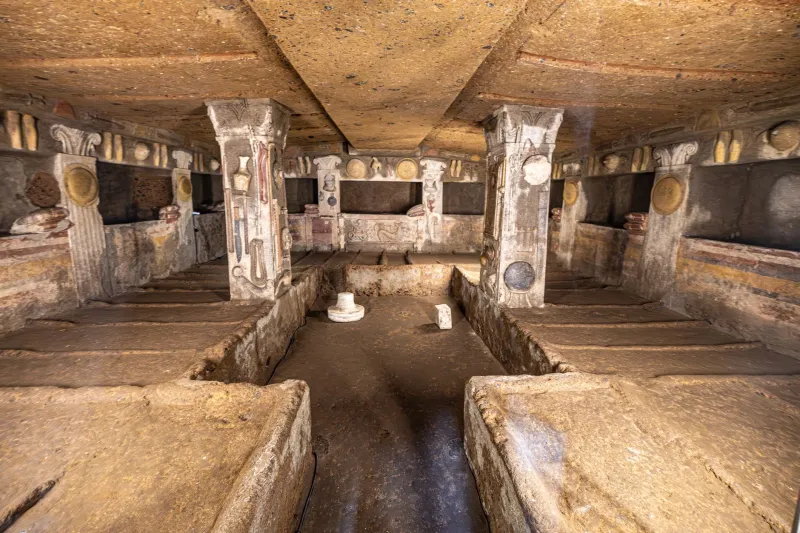
London keeps its Roman past in basements. The Walbrook Mithraeum, discovered in 1954 during construction work in the City, is the best-known example: a temple of Mithras, re-sited and displayed at Bloomberg SPACE, where visitors descend into a dimly lit reconstruction of a Roman ritual space. It is a compelling experience, and it has become a fixture of London’s Roman itinerary. It is also, repeatedly, mistaken for something Egyptian.
The confusion is understandable. The Walbrook valley was a focus of Roman ritual, and the name Isis attaches easily to any exotic deity in a city museum. But the temple by the Walbrook is Mithraic, not Egyptian. If we want to talk about Egyptian cults in Roman Britain, we need to start by putting that particular ghost to rest.
A Temple by the Walbrook, but Not for Isis
The Walbrook Mithraeum is a temple of Mithras, a god popular among Roman soldiers and officials. Its architecture, its sculptural programme and its later history have been studied in detail. Nothing in the secure record identifies it as a temple of Isis, Serapis or Harpocrates. The misidentification is a useful case study in how Egyptomania works: a subterranean temple, a mystery cult, a city with a long history of Egyptian revivals, and the loose assumption that any ‘eastern’ religion in Roman London must have come from the Nile.
That assumption does a disservice both to Roman religion and to Egyptian heritage. Roman London was religiously plural, and its inhabitants worshipped a wide range of deities from across the empire. Mithras came from the east, but not from Egypt. Isis came from Egypt, but by the Roman period she was a Mediterranean-wide goddess with temples from Pompeii to Rome. The two traditions were distinct, even if they shared the grammar of mystery cult and initiation.
What the Evidence Actually Shows
The evidence for Egyptian cults in Britain is real, but it is scattered. It consists of small finds, amulets, statuettes and inscriptions rather than standing temples. A bronze statuette of Harpocrates, the child form of Horus, is the kind of object that turns up in Romano-British contexts and is easily overlooked in a display case. Egyptianising amulets and gems circulated widely, often as personal ornaments rather than as evidence of formal cult. A handful of dedications to Isis or Serapis have been proposed, though the epigraphic record is fragmentary and demands caution.
In London, the picture is typical. The city has produced Egyptian-style objects, but no securely identified temple of Isis. Claims to the contrary tend to rest on inference rather than on a dedication or a structural sequence that can be tied to the cult. That does not make the objects insignificant. It makes them evidence of a different kind: of movement, trade, personal devotion and the porousness of Roman religious life.
Chester offers a useful comparison. Roman Deva had its own religious landscape, and its collections include objects that have been discussed in connection with eastern cults. But the evidence for an Egyptian temple at Chester is slight. No structure can be confidently identified as a Serapeum or an Iseum, and the finds are better understood as traces of individual practice than as proof of an organised cult centre. The same is true across much of the province. Egyptian religion in Britain was present, but it was rarely monumental.
Why the Egyptian Label Slips
Part of the problem is curatorial. British museums have traditionally classified Romano-British finds by province rather than by origin. A statuette of Isis found in London is catalogued as ‘Roman Britain’ because that is where it was found, not because its iconography is British. That is a defensible archaeological convention, but it has an unintended effect: the Egyptian origin of the object disappears from the label. Visitors see a Roman god, not a Nile-valley deity.
Part of the problem is cultural. Britain has a long history of Egyptian revivals, from the Egyptian Hall in Piccadilly to the obelisk on the Thames embankment. That enthusiasm has tended to blur the distinction between ancient Egypt and Roman Egypt, and between Egyptian religion and Egyptianising decoration. The result is a public conversation in which ‘Isis’ can mean almost anything, and in which a Mithraic temple can be mistaken for an Egyptian one without anyone noticing.
Reconnecting Kemet in 2026
The opening of the new London Museum at Smithfield in 2026 offers an opportunity to tighten the frame. The museum will tell the story of London from prehistory to the present, and its Roman galleries will inevitably include objects from the Walbrook and beyond. The question is how those objects are labelled and interpreted. A display that simply calls a statuette ‘Roman’ misses the chance to show how a god from the Nile travelled to the Thames. A display that calls every mystery cult ‘Egyptian’ is worse: it replaces one confusion with another.
The better approach is to be precise. Egyptian cults in Roman Britain should be presented as part of the reception of Kemet, not as a decorative footnote to Roman London. That means naming Isis, Serapis and Harpocrates where the evidence supports it, and resisting the temptation to inflate the evidence where it does not. It also means acknowledging that Roman Londoners who worshipped Isis were not practising ‘Egyptian religion’ in any simple sense. They were participating in a Roman religious world that had absorbed Egyptian deities and remade them.
That is a more honest story, and a more interesting one. It connects the Walbrook to the Nile without erasing the distance between them. It treats Roman London’s Egyptian traces as evidence of movement and exchange rather than as curiosities. And it gives visitors a way to understand why a small bronze of Harpocrates in a museum case matters: not because it proves a temple, but because it shows a god from Kemet finding a home in a cold, provincial city.
The Mithraeum mistake is easy to make and easy to correct. The harder task is to build a display that gets the distinction right. In 2026, with a new museum opening and a public hungry for Roman London, that task is worth taking seriously.