Passing the Pieces: Senet, Play and the Interpretation of Kemet in Britain
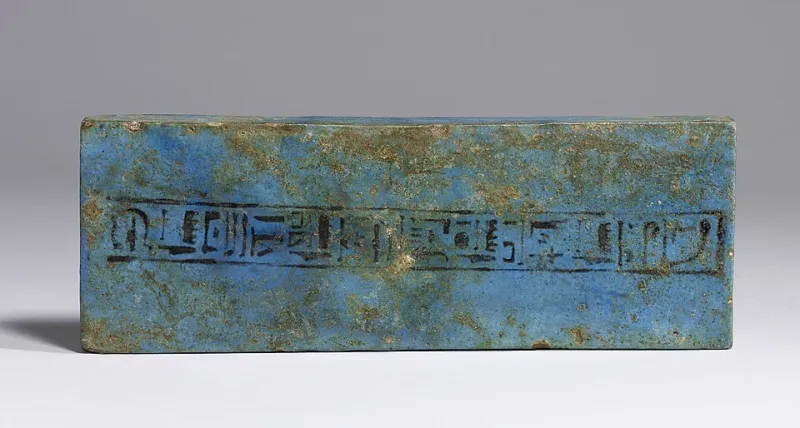
Photo: Anonymous (Egypt)Unknown author, Public domain, via Wikimedia Commons
A senet board is an unusually generous object. It offers a grid, a set of counters and a rule-set that can be explained in a few sentences. It invites handling. It can be played badly, argued over, abandoned halfway through and started again. Few categories of ancient Egyptian material carry that kind of immediate social permission — and few have travelled so far from the contexts that produced them.
From the Tomb Wall to the Tabletop
The game appears in Egyptian material culture over a very long span, from early board markings and tomb depictions through to Roman-period examples. Its imagery is familiar to anyone who has spent time in a British gallery: a rectangular grid of thirty squares, marked with signs whose meanings shifted across centuries, and a set of pieces that were moved along it. Boards survive in stone, faience, wood and plaster; some are elaborate fittings for elite burial, others are scratched into convenient surfaces. The British Museum, the Petrie Museum and the Ashmolean all hold examples, and provincial collections across the UK preserve pieces that rarely reach the display case.
The interpretive difficulty is real. No complete ancient rulebook survives. Reconstructions rest on later references, on comparative inference and on a degree of scholarly consensus that is more provisional than museum labels sometimes suggest. Yet the game's broad structure is secure enough to be played, and it has been played — in classrooms, in family workshops, in museum handling sessions and, increasingly, in commercial board-game design that borrows the senet grid for its visual authority.
That is the point at which a question worth asking emerges. What changes when Kemet is packaged as family entertainment?
The Parlour and the Display Case
Britain has a long habit of turning the ancient world into domestic amusement. Nineteenth- and twentieth-century parlour games drew freely on Egyptian motifs, and the language of the souvenir trade ran alongside the language of scholarship. The result is a peculiar inheritance: objects that were once funerary equipment sit in the same cultural memory as novelty puzzles and biscuit tins, and the boundary between instruction and diversion has never been especially firm.
Museum shops and school catalogues continue that tradition in a gentler register. A cardboard senet set, printed with a plausible grid and accompanied by a short rules sheet, is a modest thing. It is also an interpretive claim. It says that daily life in Kemet is accessible, that leisure mattered, that a board game can be a legitimate entry point into a society usually introduced through tombs and temples. Those are defensible claims, and museums are right to make them.
The risk lies elsewhere. Entertainment formats reward certainty. A game needs a rule; a family activity pack needs an answer. The temptation is to present a reconstructed senet as though it were transmitted intact, when what visitors are actually handling is a modern interpretation with a long chain of inference behind it. That is not dishonesty, but it is a compression — and compression is where nuance is lost.
What Play Can Do That Labels Cannot
None of this argues against play. It argues for play that is honest about itself. A game is one of the few interpretive devices that makes a visitor think about process rather than product: how a move is chosen, how a loss is absorbed, how a rule is negotiated between players. Applied to senet, that can open onto genuinely historical questions. Who had time to play? Where were boards found, and with what else? Why did the game's symbolism become entangled with ideas about the journey of the dead, and what does that entanglement suggest about how Egyptians thought about chance?
British museums are increasingly alive to this. Handling collections, family workshops and gallery trolleys use play to slow visitors down, and the best of them resist the urge to over-explain. A short session with a reconstructed board can do more for a visitor's sense of a lived society than a wall text listing dynasties, precisely because it produces a small, memorable difficulty. The visitor learns that the rules are uncertain, and that uncertainty is not a failure of scholarship but a feature of it.
There is a wider benefit, too. Play is a route into the ordinary. Senet was not only a royal amusement or a funerary metaphor; it was something people did together, and its presence in British collections is a reminder that the everyday is often what survives least well and interests visitors most.
The Limits of the Novelty
The caution is that play flattens quickly when it is separated from interpretation. A game sold purely on atmosphere — the gold, the hieroglyphs, the vague sense of mystery — teaches very little and reinforces an old habit of treating Kemet as a decorative repertoire. A school activity pack that presents invented rules as ancient fact does a similar disservice, even with the best intentions.
The remedy is not solemnity. It is specificity. Museums can name the objects that inspired a reconstruction, distinguish evidence from inference, and invite visitors to notice where the gaps lie. They can credit the scholarship that made the game playable and acknowledge where that scholarship disagrees. Above all, they can resist the assumption that a family audience requires simplification of the past rather than clarity about it.
Senet has survived several thousand years of changing use. It has been a grave good, an object of antiquarian curiosity, a display piece and now, once again, a game. Britain's collections are well placed to tell that whole story — not only the grid on the board, but the long, uneven journey that brought it to a table in a wet afternoon in Leeds or Cardiff. Play is a good beginning. It should not be the end of the conversation.