The Wages of Discovery: Britain’s Dig-House Ledgers and the Workers Written Out
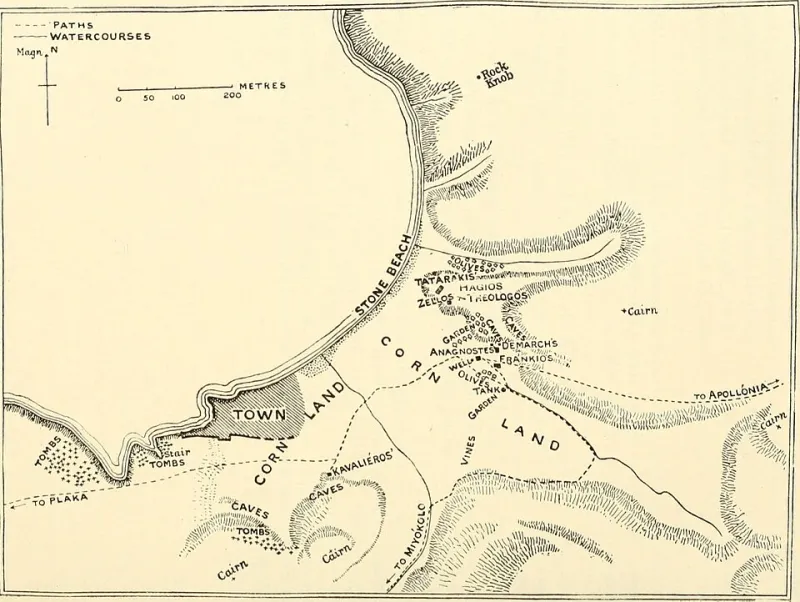
Photo: Internet Archive Book Images, No restrictions, via Wikimedia Commons
In a reading room in London, a slim wage book from an Egyptian excavation season lies open on a foam cradle. The columns are neat: date, name, role, daily rate, signature or thumbprint. To a cataloguer, it is a document of employment. To a historian of archaeology, it is a corrective. The ledger records people whom the published report, with its plates of temples and tomb groups, rarely names.
Britain’s Egyptology archives are rich in such material. The Egypt Exploration Society’s Lucy Gura Archive, the Griffith Institute in Oxford, the Petrie Museum at UCL and several regional museum collections hold excavation notebooks, correspondence, photographs, accounts and wage sheets from digs in Egypt and Sudan. These are not merely administrative leftovers. They are the closest thing many sites have to a social record of the work that made discovery possible.
What the dig-house paper trail contains
Excavation archives tend to be arranged around the excavator. Notebooks record levels, pottery lots and findspots; letters describe negotiations with landowners and officials; photographs show trenches, objects and groups of workers. Wage books and daybooks are less celebrated but often more revealing. They list the Egyptian foremen, quarrymen, basket boys, guards, cooks, water carriers and clearance teams who sustained a dig season. Smaller finds — a mud seal, a bead, a fragment of textile — are sometimes credited in notebooks to a named worker or a particular gang.
The terminology in these records is uneven. Workers may appear as ‘our men’, ‘the Quftis’, ‘the sheikh’s people’ or simply by a single name. Transliteration varies. Pay differentials are stark. The archive is therefore not a neutral window: it is a colonial administrative structure that has become, by accident, a biographical source.
The erasure in discovery narratives
Published excavation reports have generally centred on the excavator, the institution and the object. Egyptian labour appears as background colour or as a collective noun. This was not only a matter of literary convention. Publication was shaped by copyright, by the excavator’s control of the archive, and by the assumption that scientific authorship belonged to the director. The result is a record in which the people who lifted the soil are often harder to find than the pots they lifted.
The ledgers do not fully solve that problem, but they complicate it. They show skill: hereditary workmen from Qift and the Theban west bank were valued for their ability to detect mud seals, clear chambers without damage and identify anomalies in the matrix. They show continuity: families worked across seasons and generations. They show negotiation: wages, rations, travel and rest days. These are not marginal details. They are the infrastructure of Egyptology.
Cataloguing as repair
In 2026, the task for UK institutions is not simply to preserve paper but to describe it in ways that make Egyptian workers visible and researchable. That means name authority records for Egyptian personnel, with Arabic script variants and consistent transliteration where the evidence allows. It means linking wage entries to photographs, find records and letters. It means arranging some material by person and season as well as by site and excavator. It also means revising descriptive language: ‘Egyptian workmen’ is preferable to ‘native labour’, and uncertainty should be stated rather than smoothed away.
This is slow, specialist work. It requires Egyptologists, archivists and Arabic-speaking researchers. It also requires funding. UK research councils, the National Lottery Heritage Fund and university collections all support archival digitisation, but the case for Egyptian dig-house records needs to be made in terms of cultural heritage and community access, not only scholarly convenience. A catalogue record that lists a foreman’s name, his village, his seasons of work and his rate of pay is a small act of restitution.
Digitisation without extraction
Digitisation is often presented as access. It can also reproduce old inequalities if scanned images are placed online without context, Arabic-language interfaces or reciprocal partnerships. A wage book photographed at high resolution but described only in English, and searchable only by excavator name, remains difficult for Egyptian researchers and descendants to use.
A better model is emerging in several UK collections: open metadata, IIIF image delivery, downloadable datasets, and advisory input from Egyptian archives and universities. Digitisation should include Arabic cataloguing, community workshops and training exchanges. Egyptian institutions should be partners in setting priorities, not merely recipients of scanned files. Where records identify living descendants, access policies should be proportionate and humane. Openness is not the same as carelessness.
The question the ledger asks
A dig-house ledger asks who is the author of a discovery. The published report gives one answer. The wage book gives another. Britain’s Egyptology archives cannot undo the conventions of the past, but they can refuse to repeat them. In 2026, the practical work is clear: catalogue the workers, digitise the records, open the metadata and build partnerships that allow Egyptian communities to reconnect with the people behind the finds. Conservation is not only about stabilising paper. It is about stabilising memory.