A Blue That Outlasts Its World: Egyptian Blue in British Conservation Science
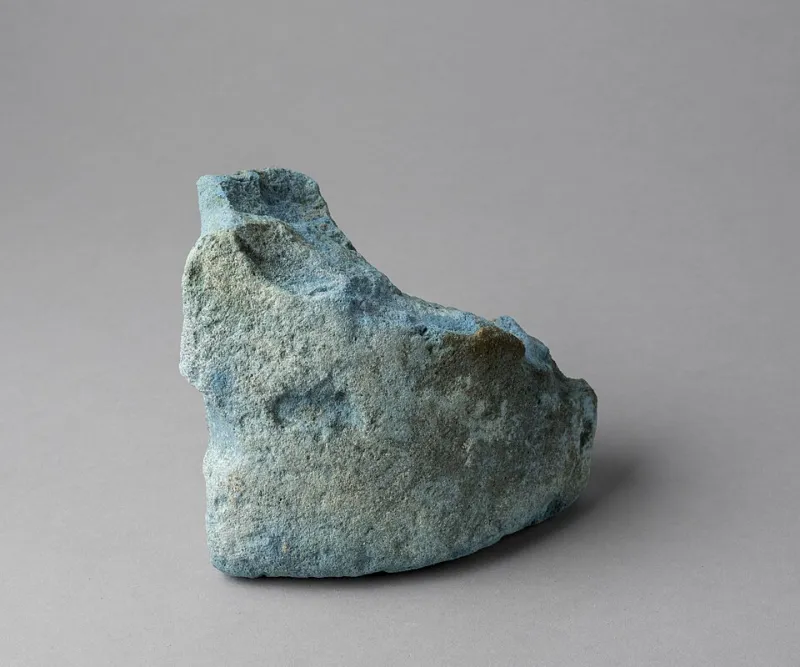
Photo: Unknown, CC0, via Wikimedia Commons
A colour with a laboratory history
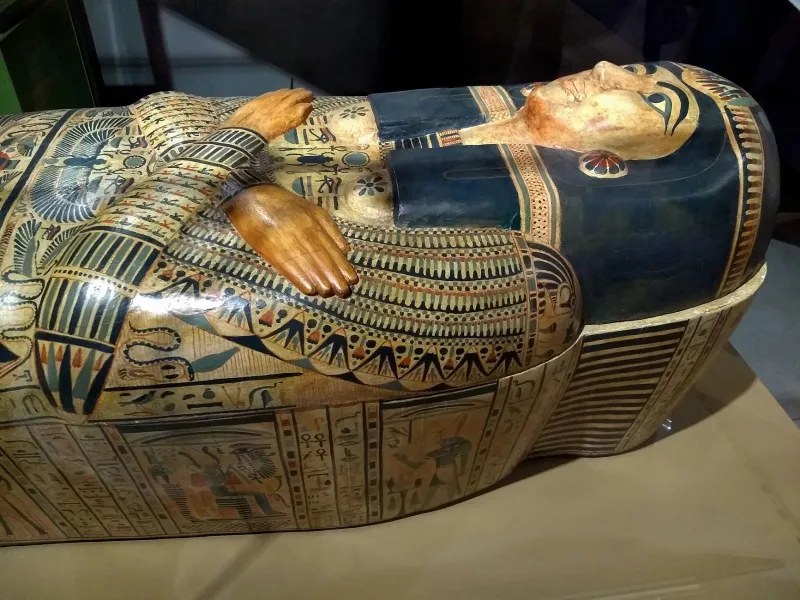
Egyptian blue is often introduced as the world’s first synthetic pigment, a phrase that can make it sound like a curiosity from the edge of chemical history. In fact, it is a carefully manufactured material: a calcium copper silicate, close in structure to the mineral cuprorivaite, produced by heating silica, a copper source, a calcium compound and an alkali flux to high temperatures. The result is not simply a strong colour. It is evidence of controlled craft, of selected raw materials and of a process that ancient workshops repeated with enough consistency to supply paintings, coffins, statuary and small objects across Kemet.
For British conservation scientists, this matters because Egyptian blue sits at a useful intersection. It is an archaeological material, a pigment with a technical recipe, and a subject that rewards non-invasive study. In museum laboratories from London to Cardiff, the question is no longer only what the colour looked like when it was applied. It is also how it was made, how it ages, how it can be identified without damage, and what its optical behaviour might still contribute to contemporary materials research.
Made, not found
The pigment’s manufacture is central to its identity. Unlike ochres or earth pigments, Egyptian blue does not come out of the ground ready to use. Its production requires knowledge of firing conditions and proportions, and the margin between a successful blue and a dull or glassy product is not wide. Experimental reconstructions have therefore become a valuable part of conservation research. By preparing small batches with different copper sources, fluxes and firing regimes, researchers can compare the resulting crystals with archaeological samples.
This work is not an attempt to rediscover a lost secret for its own sake. It helps conservators interpret variation. A pigment sample from a tomb wall, a coffin fragment or a bead may differ in texture and composition because of raw materials, workshop practice or later alteration. Reconstruction gives laboratories a reference point against which those differences can be assessed. It also makes clear that Egyptian blue was not a single, uniform product. It was a family of materials shaped by local resources and skilled judgement.
Reading a pigment without touching it
Much of the most important work in UK collections now begins with light rather than sampling. Visible-induced luminescence, often shortened to VIL, has become a familiar technique in Egyptian blue research. Under certain visible illumination, the pigment emits in the near-infrared, allowing specialists to map its presence even when the blue is faint, discoloured or hidden beneath later layers. The method is especially valuable because it can reveal traces of the pigment on objects where the visible surface no longer appears blue.
Alongside imaging, UK laboratories use techniques such as X-ray fluorescence, Raman spectroscopy, X-ray diffraction and scanning electron microscopy to examine composition and structure. Each answers a different question. Elemental analysis can indicate the presence of copper and associated materials; Raman and diffraction can help identify crystalline phases; microscopy can reveal particle size and distribution. The strongest results come when these methods are combined, and when they are interpreted alongside archaeological context rather than treated as a shortcut to meaning.
For British museums, this approach has practical consequences. It can inform display decisions, guide cleaning and support the documentation of objects that are too fragile for invasive analysis. It can also change interpretations of an object’s history. A pigment that appears absent from a painted surface may still be detectable in trace amounts; a colour that now looks green or grey may once have read as blue. Conservation science does not replace the curator’s eye, but it can sharpen it.
Reconstruction as evidence
Experimental archaeology and conservation science meet most clearly in the workshop. Reconstructing Egyptian blue requires attention to the everyday realities of ancient production: the purity of the silica, the form of copper, the availability of calcium and the behaviour of the flux. These are not abstract variables. They shape the colour, the hardness of the pigment and the way it binds with a medium.
British laboratories and university departments have used such reconstructions to test claims about ancient technology and to train the next generation of conservators. The exercise is useful precisely because it is humbling. A modern furnace may offer greater control than an ancient kiln, yet the result can still vary. That variability is not a failure of the experiment. It is a reminder that ancient craftspeople worked within material constraints and developed practical solutions that are not always visible in the finished object.
An afterlife in modern optics
Egyptian blue’s story does not end at the museum case. Its near-infrared luminescence has attracted interest beyond archaeology, including in imaging and materials science. Researchers have explored the pigment’s optical properties for applications that range from diagnostic imaging to security marking and sensor development. These are not direct continuations of ancient practice, and it would be misleading to present them as such. They are modern investigations prompted by an ancient material.
That distinction matters. The value of Egyptian蓝 to contemporary science lies less in a romantic idea of lost wisdom than in the pigment’s measurable behaviour. It is a crystalline material with unusual optical characteristics, and those characteristics can be studied, modelled and, in some cases, adapted. For a UK research culture increasingly interested in sustainable materials and heritage-led innovation, Egyptian blue offers a useful case study in how a historical material can generate new questions without being reduced to a mere precursor of modern technology.
What British collections can still yield
The British Museum, the Petrie Museum at UCL, the Ashmolean and regional collections across the UK hold Egyptian material that continues to reward close scientific attention. Much of it is well known; some of it is fragmentary, unpublished or difficult to display. Conservation science can add value to all three categories. It can refine the interpretation of famous objects, bring neglected fragments into research, and provide evidence for displays that explain manufacture as well as meaning.
In 2026, the most productive direction is likely to be collaborative. Museum scientists, university laboratories, conservators and curators each hold part of the picture. No single technique can reconstruct an ancient workshop, and no single object can represent an entire industry. What Egyptian blue offers is a manageable, tangible point of contact between Kemet and modern British research: a pigment that was made with skill, studied with care and still capable of surprising the laboratories that examine it.
The first blue may not have been the simplest colour to produce. That is precisely why it remains worth studying.