The Measured Flood: Nilometer Records and the British Climate Model
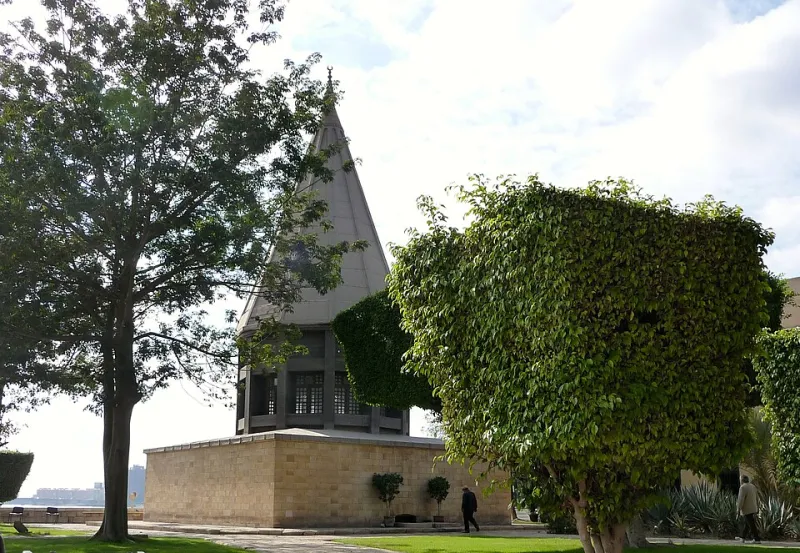
Photo: Willyman, CC BY-SA 4.0, via Wikimedia Commons
The Nile has never been a silent river. Its annual flood, the inundation that made Kemet's fields and filled its granaries, was watched, measured and argued over for millennia. What began as a practical necessity — knowing whether the water would rise high enough, or too high — became one of the longest-running environmental monitoring programmes in human history. Today, that record is being read again, this time in British laboratories and climate offices, where researchers are asking whether the Nile's ancient ledger can sharpen the models used to predict floods in the UK.
The gauge as archive
At Elephantine, a staircase cut into the granite recorded the river's height against graduated markings. At Roda Island in Cairo, a deep well with a central column served a similar purpose across centuries. These were not merely instruments. They were civic infrastructure, tended by officials, consulted by rulers, and bound up with taxation, agriculture and belief. A reading that fell short of the expected mark could mean hunger; a reading that rose too far could mean ruin.
Alongside the stone gauges, papyrus archives preserved flood heights, administrative correspondence and harvest expectations. The result is a documentary record of unusual depth: not a single century of observation but thousands of years, punctuated by political upheaval, changing measurement practices and the occasional silence of the archive. For climate scientists accustomed to instrumental records measured in decades, such length is both a gift and a puzzle.
From papyrus to database
British institutions hold a substantial share of this material, from papyri in the British Library and British Museum to collections in Oxford, Cambridge and University College London. Researchers, often working with Egyptian colleagues and the Ministry of Tourism and Antiquities, are digitising texts and objects, standardising measurements and building datasets that can be interrogated by hydrologists rather than only by philologists. The work is slow. Flood heights may be recorded in cubits, fingers or local units; dates may follow regnal years rather than a single calendar; and the reasons for a missing entry are rarely stated.
Even so, the direction of travel is clear. The Nile's flood record is moving from the reading room to the database, and from the database into the comparative work of climate science. That shift raises questions of stewardship as well as scholarship. Digitisation is not a neutral act: it requires choices about what is selected, how it is described, and who has access. British researchers are increasingly aware that the data's long journey from Egyptian archives to European servers carries obligations as well as opportunities.
What long records do for short models
Modern flood models are hungry for baseline data. They need to know how often extreme events occur, how long a river can remain within its usual range, and how quickly conditions can shift from one state to another. The Nile record offers a test case: a river whose behaviour was observed across periods of climatic stability and disruption, and whose flood heights were documented by a state with a strong interest in getting the numbers right.
In Britain, the Environment Agency's flood models and the Thames Estuary 2100 programme rely on historical records, instrumental data and projections of future change. Long records from elsewhere cannot be imported directly. The Nile is not the Thames, and Kemet's climate is not Britain's. But the Nile data can inform the assumptions that underpin British models: how much natural variability a river system can exhibit, how long an extreme event may remain absent from the record, and how quickly a society's water management can adapt when the flood no longer behaves as expected.
The most useful contribution may be statistical humility. A record that spans thousands of years makes visible the difference between a rare event and a changing baseline. It shows that rivers can settle into long periods that look stable and then move, sometimes abruptly, into another regime. For a country planning defences and drainage for the next century, that lesson is not abstract.
Learning from Kemet's water management
Kemet's water management was not only measurement; it was adaptation. Basin irrigation, dikes, canals and local governance combined to make the most of the flood and to limit its damage. Maintenance was continuous, and responsibility was distributed. The system was not perfect, and it did not prevent every failure, but it endured for a very long time.
The lesson for the UK is not to copy ancient engineering. It is to recognise that adaptation is a long-term administrative practice, not a single infrastructure project. Flood risk management in Britain increasingly speaks of catchment-wide approaches, natural flood management and community resilience. Kemet's experience suggests that the slow variables — maintenance, local knowledge, clear responsibility and the willingness to revise expectations — matter as much as the headline structure.
The limits of the ledger
None of this is straightforward. The Nile records are uneven, their units and dates are not always compatible, and the reasons for their creation were administrative rather than scientific. Colonial-era archives add another layer of complication, and the movement of objects and texts between Egypt and Britain remains a subject of legitimate debate. Researchers who use these records must be honest about their gaps and careful about their provenance.
There is also a risk of overreach. Ancient water management cannot be transplanted into a modern state with different institutions, different demographics and a different climate. The point is not that Kemet had answers. The point is that Kemet kept records long enough to show how a society lived with a river that did not always keep its promises.
A shared gauge
The Nile's ledger is not a relic. It is a dataset, a heritage collection and a record of human adjustment to an uncertain environment. As British researchers continue to digitise and analyse it, the work will need to be done in partnership, with Egyptian institutions setting the terms of access and interpretation. If that is done well, the reward is more than a refined model. It is a longer view of what it means to live with water — a view that Britain, as it faces its own changing climate, can ill afford to ignore.