The Obelisk by the Bus Stop: London’s Cleopatra’s Needle and the Everyday Work of Stewardship
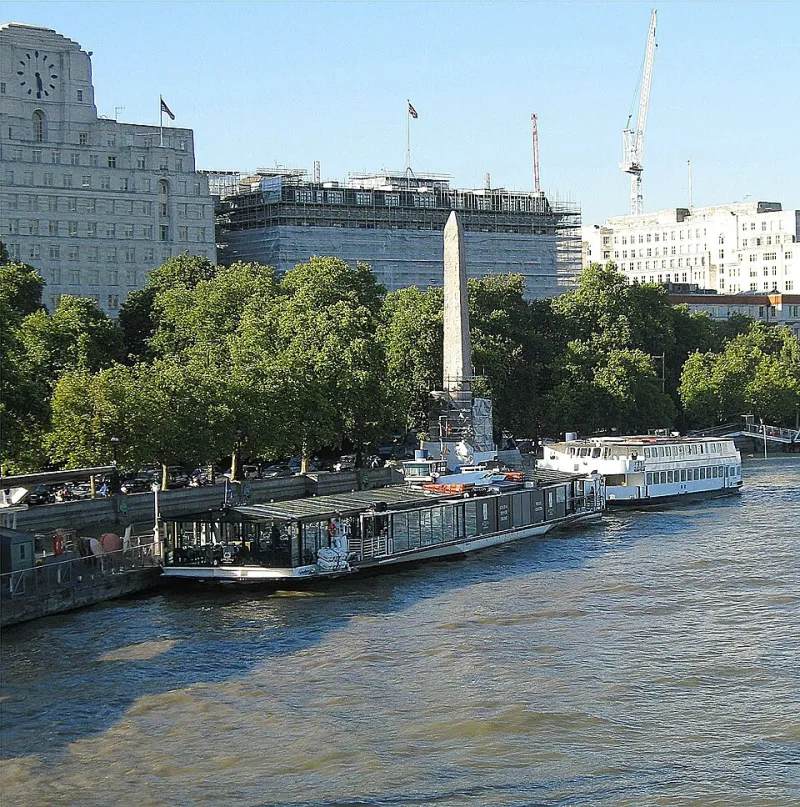
Photo: Glenn Ashton, CC BY-SA 3.0, via Wikimedia Commons
On the Victoria Embankment, between the river and the traffic, an obelisk stands close enough to a bus stop that few commuters look at it twice. The monument known as Cleopatra’s Needle is one of London’s most conspicuous ancient objects, yet it is also one of the least museum-like. It has no vitrine, no timed entry and no interpretative gallery. It has weather, pigeons, road grit and a long history of being moved.
That combination makes it a useful case study for conservation in Britain. The obelisk is ancient, but its life in London is modern. It is a monument that has been borrowed, shipped, damaged, repaired and reclassified by the city around it. To ask how it should be cared for is to ask a broader question: what does stewardship mean when an ancient object is also public furniture?
From Heliopolis to the Thames
The London obelisk was not made for London. It was erected at Heliopolis, in Egypt, during the reign of Thutmose III, and later moved to Alexandria in antiquity. Its association with Cleopatra is traditional rather than secure; the name has stuck because it is memorable, not because it is precise. In 1819, Muhammad Ali presented the obelisk to Britain. It was not until 1877 that the practical business of moving it began.
The delay matters. For much of the nineteenth century the obelisk was a diplomatic gift without a settled destination, a monument whose future depended on money, engineering and public enthusiasm. Its arrival in London was not the recovery of an object from obscurity. It was the beginning of a new set of problems.
The Voyage and Its Costs
The transport was an engineering spectacle. The obelisk was encased in a cylindrical pontoon, the Cleopatra, and towed from Alexandria. In the Bay of Biscay the tow line failed and the pontoon was adrift for days. Six men died in the attempt to recover it. The obelisk eventually reached London, was erected on the Embankment in 1878, and was paired with two bronze sphinxes.
These details are often told as an adventure story, and they are certainly dramatic. But they also establish a pattern that has defined the obelisk’s London life: care is reactive. Action follows crisis, damage or public concern. The monument is attended to when something goes wrong, then allowed to recede into the background of the city.
Weather, Graffiti and Accident
The obelisk bears the marks of its exposure. Its granite has weathered, its inscriptions have been studied and debated, and its surface carries graffiti from the nineteenth and twentieth centuries. Some of this graffiti is now historic in its own right. Damage from a First World War bomb is part of its record. The monument has been, by turns, a curiosity, a patriotic symbol, a meeting point and an obstacle to be cleaned around.
This is not simply a story of neglect. Conservation work has been carried out, and the obelisk has been monitored and treated. But the terms of its care are different from those of a museum object. Conservators must balance the stone against public access, traffic pollution, river damp and the ordinary wear of a well-used public space. The obelisk cannot be removed from the environment that is slowly changing it.
Conservation Without a Vitrine
That is the central conservation dilemma. A museum can control light, humidity and handling. A public monument cannot. The Embankment is a living streetscape, and the obelisk is exposed to exactly the conditions that conservation tries to limit. Any treatment must therefore be modest, reversible and repeatable. Cleaning cannot be so aggressive that it removes the surface history. Repair cannot pretend that damage has not happened.
There is also an interpretative problem. The obelisk is often described as if it were simply an ancient Egyptian object that happens to be in London. In practice it is a monument with several lives: Egyptian, Alexandrian, Victorian, imperial, civic and contemporary. Its labels, plaques and surrounding furniture rarely carry that complexity. Visitors are told what it is, but not always what has happened to it.
Stewardship as Public Memory
A better approach would treat the obelisk as a conservation case with a public audience. That means clear, durable interpretation that explains its origins, its removal, its voyage, its damage and its repairs. It means acknowledging that the monument’s presence in London is a historical fact with political dimensions, not a neutral decoration. It also means accepting that the obelisk will continue to change, because the city around it will continue to change.
The obelisk by the bus stop is therefore not a failure of museum standards. It is a different kind of conservation problem. Its value lies precisely in its exposure: it asks the public to think about ancient stone in a living city, and about the difference between keeping an object safe and keeping it present. In 2026, as London’s public realm is increasingly managed for movement and safety, that distinction deserves more attention than the monument usually receives.