Small Gods in the Drawer: Britain’s Egyptian Revival Jewellery as Private Heritage
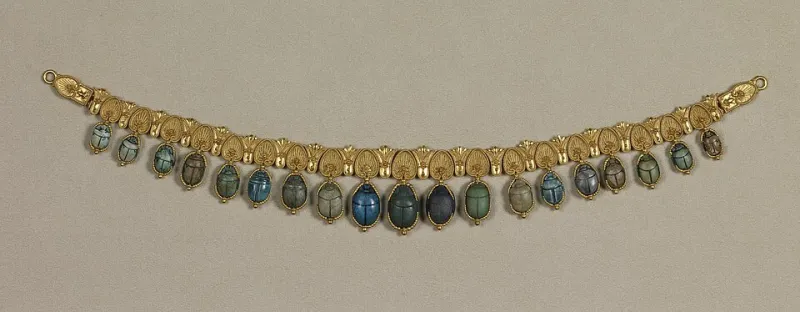
Photo: Giacinto Melillo, Public domain, via Wikimedia Commons
On a dressing table in Britain, a scarab brooch can sit for decades without attracting a curator's attention. It is small, often uninscribed to the eye, and entirely at home among family jewellery. Yet it belongs to one of the widest and least documented categories of Kemet-related material in the country: the Egyptian Revival ornament, bought, inherited and worn by people who never thought of themselves as collectors.
That ordinariness is precisely what makes the subject worth attention. Museum scarabs are catalogued, photographed and interpreted. Their private counterparts are frequently stored in tins, threaded onto modern chains, or passed down with a story that has lost its middle. In 2026, as British institutions continue to rethink how Egyptian material is displayed and explained, the jewellery box offers a modest but revealing parallel archive.
From the Dig to the Jeweller's Window
The Victorian craze for Egyptian motifs was not simply a matter of fashion. It grew from Britain's deepening involvement in excavation, tourism and imperial administration in the Nile valley. Small antiquities moved through dealers, travellers and dig houses into British hands, and jewellers found a ready market for scarabs set as brooches, pendants and cufflinks. Some settings held genuine amulets; others held reproductions, or pieces carved to satisfy demand.
The distinction was not always important to the buyer. A scarab could be valued as a seal, a souvenir, a talisman or a talking point. Set in gold or silver, it became a personal ornament that carried a suggestion of ancient wisdom without requiring its wearer to read a single hieroglyph. The object had crossed from ritual context into British domestic life, and its meaning had changed with the crossing.
Travel shaped the market. Thomas Cook's Nile tours from the later nineteenth century made Egypt more accessible to middle-class Britons, while wealthier travellers assembled collections on a grander scale. The jewellery that returned home reflected those differences. A finely made Victorian brooch might signal connoisseurship; a modest silver pendant could mark a once-in-a-lifetime journey. In both cases, the ornament was a compact form of travel writing, worn on the body.
The Tutankhamun Effect
The discovery of Tutankhamun's tomb in 1922 gave Egyptian Revival design a new intensity. In Britain, the 1920s produced jewellery and costume pieces that borrowed freely from lotus capitals, winged sun discs, uraei and the angular geometry of painted tomb scenes. The motifs appeared in fine jewellery and in inexpensive dress ornaments, moving between classes and materials with unusual speed.
The later British Museum exhibition of 1972 repeated the effect for a new generation. Families who would never buy a genuine antiquity could still own a scarab ring, a pendant or a pair of earrings in the Egyptian style. These objects are often dismissed as costume jewellery, but that judgement misses their role. They show how Kemet entered ordinary British visual culture, not only through scholarship but through department stores, fashion magazines and holiday souvenirs.
The Genuine and the Copy
The most difficult question raised by these pieces is provenance. A scarab set in a brooch may be an ancient amulet, a nineteenth-century copy, or a modern reproduction. Without documentation, the difference can be hard to establish, and the setting itself may obscure the object's surface and inscriptions. Families are often unsure whether they own a curiosity, a souvenir or something that should be reported to a museum.
The answer is rarely dramatic. Many private ornaments contain small antiquities that left Egypt during the nineteenth or early twentieth century, when collecting practices and export rules were very different from those of today. That history should be acknowledged without turning every heirloom into a case study in guilt. The more useful response is documentation: photograph the piece, record what is known of its purchase or inheritance, and seek advice from a local museum curator or a finds specialist if the object appears to be ancient.
Museums cannot catalogue what they cannot see. A light-touch record of private Egyptian Revival jewellery would help scholars understand the distribution of motifs, the routes by which small antiquities travelled, and the social range of British collecting. It would also give families a clearer sense of what they hold.
Care in the Home
Conservation begins with restraint. Gold is comparatively stable, but silver tarnishes, enamel can chip, and faience or steatite scarabs may be porous and sensitive to salts, adhesives and abrupt changes in humidity. Vintage boxes lined with acidic paper or foam can do quiet damage over time. Direct sunlight fades textiles and can stress some mounting materials.
The safest approach is modest: keep pieces dry, stable and out of direct light; store them separately to avoid abrasion; avoid abrasive polishes and home cleaning agents; and photograph them before any intervention. If a setting is loose or a surface is flaking, a conservator should be consulted rather than a jeweller who normally works on modern pieces. The point is not to freeze the object in time but to slow avoidable change.
Private Heritage, Public Conversation
The scarab in the jewel box is not an alternative to museum interpretation. It is part of the same larger history, dispersed into private hands and often kept without context. Recognising that history does not require every family to become a collector or every ornament to become an exhibit. It requires only that we treat these small objects as more than decoration.
In 2026, the most productive conversation may be a local one: museum documentation days, careful loans for study, and plain-language advice on provenance and care. A brooch can remain a brooch while also being understood as a fragment of Britain's long, complicated relationship with Kemet. The small god in the drawer deserves that much attention.