The Olfactory Archive: Rebuilding Kemet's Incense in British Laboratories
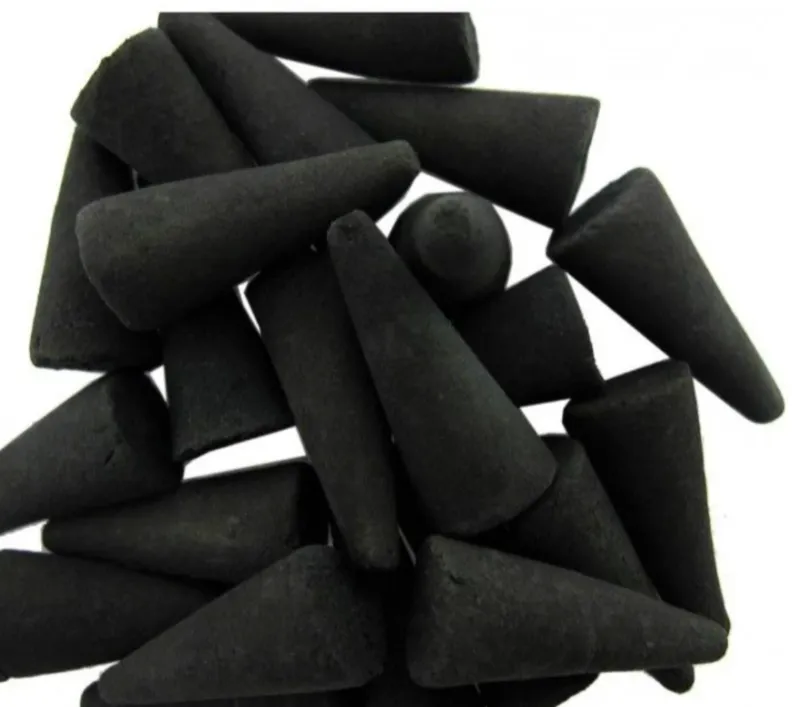
Photo: incense resin smoking in shallow ceramic bowl, dark moody background, close-up, via cdn.faire.com
A temple in Kemet was never silent, and it was never odourless. The daily service of offering was accompanied by smoke: resin heated on braziers, gums dissolved in wine, aromatic woods smouldering in shallow bowls. The gods, the texts suggest, were fed on it. The human nose, standing in the cool of a stone sanctuary, met something dense and sweet, cut with the sharpness of pine and the sweetness of honeyed fruit. That experience has no surviving recording. What survives is a smear.
In laboratories in Bristol, London and Cambridge, that smear is being made to speak.
What the Residue Can Say
The evidence is unglamorous. A dark patch inside a ceramic dish from a temple storeroom. A crust on the interior of a jar. A thin film on the base of a limestone burner. Organic residue analysis, the discipline that has transformed the study of ancient diet and craft, applies the same logic here: absorbent or porous materials trap lipids, resins and waxes, which survive far longer than the substances that carried them.
Gas chromatography–mass spectrometry allows a chemist to separate a complex mixture into its components and identify them against reference libraries. Certain markers are durable and reasonably diagnostic: the triterpenoids associated with frankincense and myrrh, the distinctive signatures of Pistacia resin, the diterpenoid compounds of conifer wood and pitch. Others are far more ambiguous. A degraded molecule can be consistent with several plants, and contamination from handling, storage and earlier conservation treatment is a constant concern.
British institutions hold a great deal of the material. Egypt Exploration Society excavation archives, the Petrie Museum's ceramic corpus and the storage collections of regional museums all contain vessels whose interiors have never been systematically sampled. The obstacle is not principally technical. It is that sampling is destructive, that permissions are needed, and that the number of laboratories with both the equipment and the expertise is small.
Reading the Recipes
The textual record is richer than is often assumed, and far less helpful than one might hope. Recipes for incense appear in the Ebers Papyrus, in temple inscriptions of the Ptolemaic period, and in the well-known accounts of kyphi preserved by Greek and Roman authors. The Edfu temple walls, in particular, preserve detailed lists of ingredients and proportions for aromatic mixtures burned in the daily cult.
The difficulty is that these are not cooking instructions. They are theological statements as much as practical ones, using plant names whose identification remains disputed. Some designations appear once in the entire corpus. Others may refer to a part of a plant rather than the plant itself, or to a preparation rather than a raw material. A list that reads, to a modern eye, like a recipe, may be a schematic arrangement of symbolic equivalences in which the smoke of the offering is understood to ascend as a material prayer.
This is where the laboratory and the philology must be used together. Residue can confirm that a substance was present; it cannot confirm that it was understood in the way a Ptolemaic priest understood it. A reconstruction that satisfies the chemist may still misrepresent the rite.
The Trade Behind the Smoke
The aromatics of Egyptian ritual were, almost without exception, imports. Frankincense and myrrh came from the Horn of Africa and southern Arabia, arriving by way of the Red Sea routes and the desert roads that fed them. The celebrated expedition to Punt, commemorated in the reliefs of Hatshepsut's mortuary temple at Deir el-Bahari, is the best-known articulation of that dependency: thirty-one incense trees, transported to be planted at Thebes, according to the texts.
Pistacia resin and cedar appear to have reached Egypt from the Levant. Juniper travelled from farther north. The consequence is that every brazier in every temple was, in a literal sense, a map of commercial reach. To reconstruct an incense recipe is to reconstruct a supply chain, and to acknowledge that the olfactory world of Egyptian religion was built on maritime and overland trade of considerable scale.
Between Reconstruction and Invention
The practical work of reconstruction is being undertaken partly by specialists in heritage science and partly by perfumers, whose training gives them an ear, or rather a nose, for how materials behave in combination. The two communities approach the problem differently. The scientist aims at identification; the perfumer aims at effect. A mixture can be chemically accurate and sensorially dead, because the proportions, the grade of resin and the temperature of burning all shape the outcome as much as the ingredients do.
Some of the herbs and woods named in the sources are not obtainable in modern Britain in the form an ancient supplier would have handled. Substitution is unavoidable. So is selection: a reconstruction is always a choice among plausible readings, presented as if it were a single thing.
Can a Museum Case Hold a Smell?
There is a further question, and it is the one that matters most for British galleries in 2026. Olfactory heritage is now an established field of enquiry, and scent interventions have moved from novelty to considered display method in several UK institutions. The technical problems are surmountable: microencapsulated patches, diffusion units, sealed scent boxes. The conceptual ones are not.
A smell placed beside an object is an assertion. It implies that this is what the object smelled of, and that this experience is commensurate with the ancient one. Neither claim is straightforwardly true. Visitors bring their own olfactory associations, and a museum scent is encountered in a room of floor polish, other visitors and climate-controlled air. The setting changes the perception as surely as the mixture does.
There is also a conservation argument. Diffused aromatics are volatile organic compounds, and volatile organic compounds are precisely what preventive conservation exists to manage. Any gallery introducing scent must justify it against the material risks to the collection it surrounds.
What the Nose Knows
The most defensible position is also the least dramatic. A reconstructed incense should be presented as an interpretation, labelled as such, and offered alongside the residue evidence and the textual uncertainty that produced it. It should be understood as a research output rather than an atmosphere.
That is a modest ambition for a sensory heritage project, and it is honest. The smoke of an Egyptian temple is gone; what remains is a chemistry of traces and a vocabulary of disputed plant names. Rebuilding soundly means admitting the gap, and letting the visitor stand in it.