The Unpeopled Ruin: Victorian Egypt Photography and the Work of Repair
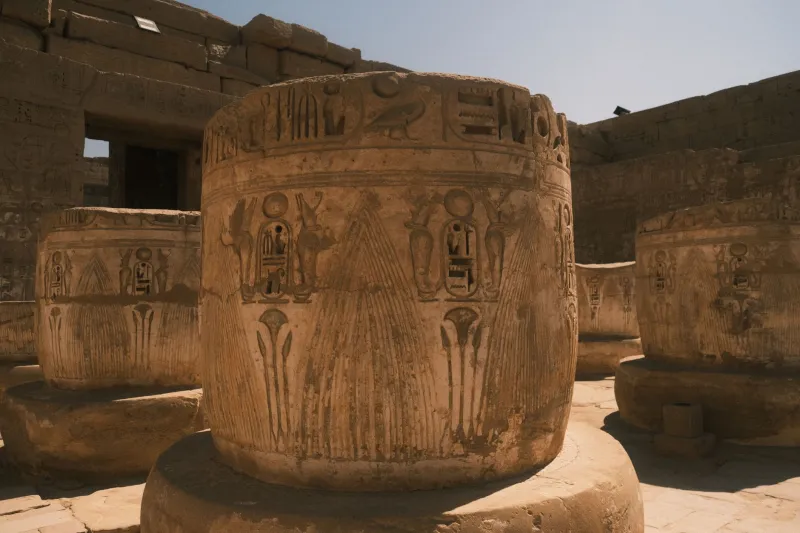
In the print rooms of British libraries and museums, Victorian photographs of Egypt often present a familiar scene: a temple colonnade, a pyramid plateau, a fall of light on stone, and almost no one in sight. The effect is of a civilisation preserved without interruption, awaiting the camera. Yet the quiet is an editorial achievement. The albums held by institutions such as the British Library, the Victoria and Albert Museum, the Royal Collection Trust and National Museums Scotland are not neutral windows onto Kemet. They are carefully composed arguments about what antiquity should look like, and about who belongs in the frame.
The album as argument
The photographs of Francis Frith and his contemporaries were made for a British market that wanted Egypt as a landscape of antiquity and biblical association. Albums were sold as souvenirs and as instruments of instruction. Their sequence mattered: a view of the Sphinx, a temple gateway, a stretch of Nile, a desert horizon. Captions often supplied a classical or scriptural vocabulary, directing the viewer towards reverie rather than enquiry. The modern country — its towns, railways, telegraph lines, cotton fields and crowded streets — was not simply absent. It was edited out through choices of viewpoint, timing and framing.
That editing was not always crude. Some Victorian photographers did include Egyptian figures, but usually as staffage: a solitary man beside a colossus to indicate scale, a group posed at a threshold, a camel train crossing the middle distance. These figures are rarely named. They function as picturesque accessories in a composition whose real subject is stone. The result is a visual hierarchy that makes labour invisible and antiquity absolute.
Labour at the edge of the frame
The production of these photographs depended on local knowledge and local work. Photographers needed dragomans, porters, guards, cooks and guides. They needed people to clear sand, hold equipment and carry fragile plates. Early processes also imposed technical limits: long exposures made moving figures blur, and photographers often preferred still or posed subjects. But technical constraint does not explain the whole aesthetic. Framing, cropping, printing and captioning were human decisions, repeated until they became a convention.
For UK collections, this matters because the album is an object with a history of use. Its mounts, handwritten captions and collector's marks are part of the evidence. A photograph that appears to show an empty ruin may sit on a page beside a caption that names a dynasty but not a village, or beside a dealer's note that records a purchase in Cairo. These details do not answer every question, but they show that the image was made and circulated within a network of travel, commerce and imperial administration.
What digitisation can recover
The digitisation and cataloguing work under way in 2026 offers a chance to recover some of that context. High-resolution scanning can reveal faint inscriptions, albumen tones, retouching and the physical structure of mounts. It can make fragile albums accessible without repeated handling, which is a genuine conservation gain. But digitisation is not automatically reparative. A database record that reproduces a colonial caption without comment can entrench the original framing rather than explain it.
Curators should therefore record several layers of description: what the photographer intended, what the image shows, what it omits, and what is documented versus inferred. Original captions can be retained as historical evidence while being clearly marked as such. Provenance, process and date should sit alongside revised public descriptions. Where local names are unknown, the record can say so. Where a figure is unidentified, that anonymity is itself a historical fact worth noting. The aim is not to invent evidence, but to make the limits of the record visible.
Captioning for schools and general visitors
For school groups, these photographs can be unusually effective teaching objects, precisely because they invite questions about evidence. A caption might begin: this photograph shows the temple as a Victorian photographer chose to frame it. It does not show the workers who cleared the site, the families who lived nearby, or the modern transport that made the visit possible. Pupils can then compare the image with later photographs, engravings or archaeological plans. The exercise teaches source criticism without requiring specialist vocabulary.
For general visitors, the tone should be plain and neither accusatory nor defensive. Labels can explain that many Victorian albums presented Egypt as an empty stage for antiquity, and that this presentation was shaped by commercial taste and imperial politics. The word empty should be used cautiously, because it describes a convention rather than a fact. A useful label might say: the photographer framed this view to exclude the modern town and its inhabitants. Such wording is neutral, specific and historically accountable.
Conservation beyond the print
The material conservation of these albums remains essential. Bound volumes can be damaged by disbinding, and albumen prints are sensitive to light, humidity and handling. UK institutions have rightly invested in controlled storage and digital access. But conservation also has an interpretive dimension. To preserve an album is to preserve the conditions in which it was made, including its omissions. The task for 2026 is not to restore a lost innocence to the colonial photograph, nor to discard it as unusable. It is to care for the object while refusing to let its silences pass as natural.
A photograph of an unpeopled ruin can still be beautiful. It can also be a document of encounter, labour and selection. The difference lies in the caption, the catalogue and the conversation around it. British collections now have the opportunity to show Victorian Egypt albums as both artefacts and arguments — and to let the people at the edge of the frame return, at least as a question.