What the Tide Left Behind: Kemet's Stone in Britain's Dock Walls
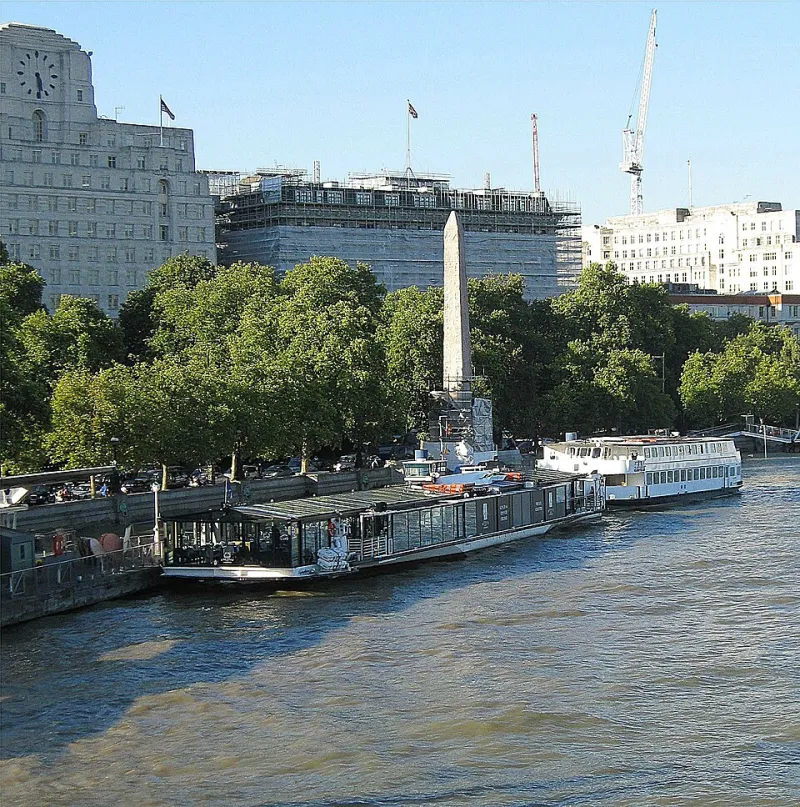
Photo: Marathon , CC BY-SA 2.0, via Wikimedia Commons
Stand on the foreshore at Limehouse at low water and the river returns its usual catalogue: clay pipe stems, slag, oyster shell, the occasional abraded sherd of Roman tile. Now and then something else turns up — a lump of coarse grey stone, or a pale, close-grained fragment that plainly does not come from the Thames basin. Some of it is ballast: the cheap, heavy, disposable weight that kept underloaded ships upright on the voyage home.
Ballast is the least glamorous cargo in maritime history and, for that reason, among the least studied. It was quarried, loaded, discharged, sold and reused, and was almost never recorded with the care given to goods that paid duty. Yet the material is still here, in quay walls, dock foundations, cellar floors, churchyard paths and the made ground beneath half the warehouses of east London. Some of it, on the evidence of the stone itself, came from Egypt.
The economics of weight
A ship is a lever with a poor sense of balance. Unladen, it rides high, rolls hard and answers the helm badly. From the age of sail onward the remedy was to take on weight: where a paying cargo was available, cargo served; where it was not, the master bought stone, shingle, sand or chalk from a ballast contractor and sailed.
The trade ran in both directions and was regulated early. In London, ballast was a licensed business from at least the seventeenth century, worked by lightermen who dredged shingle from the river and sold it back to outward-bound vessels. Returning ships discharged their weight at ballast quays along the Thames — the name survives at Greenwich — and the spoil was sold on to builders, bargees and anyone with a hollow to fill. Newcastle had its Ballast Hills; Bristol had its ballast wharves; Liverpool and Sunderland had their own tipping grounds. Every port of consequence had a place where the world's unwanted geology was emptied out and, sooner or later, built with.
Egypt entered that traffic through Alexandria and Port Said. Vessels that had carried coal, machinery or Lancashire goods south could not always find a full return cargo, and a ship leaving Egypt light needed weight of some kind. Soft Nubian sandstone, nummulitic limestone from the Cairo plateau, pink granite from Aswan: all were available at the quay, heavy, and worthless enough to dump.
What the records show — and do not
Here the honest answer is that the documentary trail is thin, uneven and frequently ambiguous. Harbour board ledgers record tonnages far more often than origins; a line reading "ballast, 40 tons, from the Levant" tells you almost nothing. Newspaper notices complain about the state of the ballast grounds without naming the ships that fed them. Ships' logs, where they survive, list ballast taken on and discharged, but rarely its character.
The consequence is that the phrase "Egyptian ballast" is used in Britain more freely than the evidence warrants. Much of the foreign stone in British quay walls is Scandinavian, Irish or Mediterranean; much of the apparently exotic stone in the Thames is Kentish ragstone or chalk that has travelled badly and weathered worse. Any claim worth making has to survive petrography. Thin-section analysis can separate Aswan granite from Cornish, nummulitic limestone from Portland, quartzite from gritstone. Where that work has been done, it has usually been done for reasons of structural engineering rather than antiquarian curiosity, and the results sit in consultancy reports that no museum will ever accession.
Reading a wall
Take the walk anyway. Bristol's Floating Harbour, completed in the first decade of the nineteenth century, retains stretches of quay wall that incorporate reused and imported stone; the older wharves around the city centre reward close looking. Liverpool's docks, rebuilt on a vast scale in the nineteenth century, were filled and faced with whatever came to hand, and the fabric of the Albert Dock area has been examined repeatedly by building archaeologists. In London, the foreshore between Wapping and Deptford offers the best free geological survey in Britain, though the tide sets the opening hours.
What you are looking for is not a monument. It is a texture: a block that does not match its neighbours, a pinkish coarse-grained lump in a wall of grey, a fragment with a dressed face that has no business being in a foundation. The pleasure of the search is precisely that it has no official itinerary. Kemet, in these walls, is not interpreted; it is simply present, holding up a parapet.
The ethics of the fragment in situ
The temptation, on finding a carved face in a dock wall, is to want it out. That instinct should be resisted. A block in a wall retains information — its position, its mortar, its relationship to the structure around it — that is destroyed the moment it is levered free. It is also, in the great majority of cases, legally unremarkable: English law does not treat a lump of Egyptian stone in a British quay as treasure, and the Dealing in Cultural Objects (Offences) Act 2003 is directed at objects removed from monuments and sites abroad, not at Victorian ballast.
The better practice is dull and useful. Photograph, measure, record the location precisely, and report anything with carving or inscription to the relevant historic environment record and to the local museum service. Encourage the port authority to note it in its own asset records. Publish, even briefly. Britain's Kemet story is not only a story of collections; it is a story of infrastructure, and infrastructure is documented by surveyors rather than curators.
There is a further point of principle. Ballast stone is the least privileged category of Egyptian material in Britain: unprovenanced by definition, unglamorous, and impossible to restitute to any identifiable place. That does not make it unimportant. It makes it a test case for how seriously we take the ordinary. The next time a storm strips render from a harbour wall, something will be exposed that has not been seen since a master in Alexandria decided his ship was riding too high. Someone should be ready to write it down.